Analysis of common faults in the main circuit The main circuit is mainly composed of three-phase or single-phase rectifier bridge, smoothing capacitor, filter capacitor, IPM inverter bridge, current limiting resistor, contactor and other components. Many of these common faults are caused by electrolytic capacitors. The life of an electrolytic capacitor is mainly determined by the DC voltage applied to both ends and the internal temperature. The capacitor model has been selected during circuit design, so the internal temperature plays a decisive role in the life of the electrolytic capacitor. Electrolytic capacitors will directly affect the service life of the inverter. Generally, every time the temperature rises by 10°C, the service life will be halved. Therefore, on the one hand, the appropriate ambient temperature must be considered during installation, and on the other hand, measures can be taken to reduce the pulsating current. Using AC or DC reactors with improved power factor can reduce ripple current and thereby extend the life of electrolytic capacitors.
When maintaining capacitors, the deterioration of electrolytic capacitors is usually judged by the relatively easy-to-measure electrostatic capacity. When the electrostatic capacity is less than 80% of the rated value and the insulation impedance is below 5 MΩ, the electrolytic capacitor should be replaced.
Typical fault analysis of the main circuit Fault phenomenon: Overcurrent trip occurs during acceleration, deceleration or normal operation of the frequency converter.
First of all, it should be distinguished whether it is caused by the load or the frequency converter. If it is a fault of the inverter, you can query the current at the time of tripping through historical records. If it exceeds the rated current of the inverter or the setting value of the electronic thermal relay, and the three-phase voltage and current are balanced, you should consider whether there is an overload. Or sudden change, such as motor stall, etc. When the load inertia is large, the acceleration time can be appropriately extended. This process will not damage the frequency converter itself. If the current during tripping is within the rated current of the inverter or within the setting range of the electronic thermal relay, it can be determined that the IPM module or related parts are faulty. First, you can determine whether the IPM module is damaged by measuring the forward and reverse resistances between the main circuit output terminals U, V, and W of the frequency converter and the P and N terminals on the DC side respectively. If the module is not damaged, the driver circuit is faulty. If the IPM module overcurrents during deceleration or the inverter trips due to a short circuit to ground, it is usually due to a fault in the module of the upper half bridge of the inverter or its drive circuit. If the IPM module overcurrents during acceleration, it is usually due to a fault in the module of the lower half bridge or its drive circuit. Some circuit faults are caused by external dust entering the inverter or a humid environment.
Control loop fault analysis The power supply part of the control loop affects the life of the inverter, which is the smoothing capacitor and the buffer capacitor in the IPM circuit board. The principle is the same as mentioned above, but the pulsating current passing through the capacitor here is basically not affected by the main loop load. Affects the fixed value, so its life is mainly determined by temperature and power-on time. Since the capacitors are all welded on the circuit board, it is difficult to judge the deterioration by measuring the electrostatic capacity. Generally, it is estimated whether the capacitor is close to its service life based on the ambient temperature and usage time of the capacitor.
The power circuit board provides power to the control loop, IPM drive circuit, surface operation display panel, fan, etc. These power supplies are generally obtained by rectifying the DC voltage output from the main circuit through switching power supplies. Therefore, if a certain power supply is short-circuited, in addition to damaging the rectifier circuit of this circuit, it may also affect other parts of the power supply. For example, due to misoperation, the control power supply and the public ground are short-circuited, resulting in damage to the switching power supply part on the power circuit board and the fan. A short circuit in the power supply causes other power supplies to lose power, etc. Generally, it is easier to find by observing the power circuit board.
The logic control circuit board is the core of the inverter. It integrates large-scale integrated circuits such as CPU, MPU, RAM, EEPROM, etc. It has high reliability and the probability of failure itself is very small. However, sometimes all the control circuits will be lost due to power-on. The terminals are closed at the same time, causing an EEPROM fault in the inverter. This only needs to be reset to the EEPROM.
The IPM circuit board contains drive and buffer circuits, as well as overvoltage, phase loss and other protection circuits. The PWM signal from the logic control board inputs the voltage drive signal into the IPM module through optical coupling. Therefore, while detecting the mode speed, the optocoupler on the IPM module should also be measured.
Cooling system The cooling system mainly includes heat sinks and cooling fans. Among them, the cooling fan has a short life. When the service life is approaching, the fan will vibrate, the noise will increase and finally stop, and the inverter will trip due to IPM overheating. The life of the cooling fan is limited by the bearing, which is approximately 10,000 to 35,000 hours. When the frequency converter operates continuously, the fan or bearing needs to be replaced every 2 to 3 years. In order to extend the life of the fan, the fan of some products only runs when the inverter is running instead of when the power is turned on.
External electromagnetic induction interference If there are interference sources around the inverter, they will invade the inside of the inverter through radiation or power lines, causing the control loop to malfunction, causing abnormal operation or shutdown, and even damaging the inverter in severe cases. Specific methods to reduce noise interference include: installing absorbing devices to prevent impulse voltage, such as RC surge absorbers, on the control coils of all relays and contactors around the frequency converter. The wiring should not exceed 20 cm; try to shorten the configuration of the control loop. line distance and separate it from the main circuit; the distance between the twisted joints of the inverter control circuit wiring should be more than 15 mm, and the distance between the inverter and the main circuit should be more than 10 cm; when the inverter is far away from the motor (more than 100 m), At this time, on the one hand, the cross-sectional area of the wire can be increased to ensure that the line voltage drop is within 2%. At the same time, an inverter output reactor should be installed to compensate for the charging current of distributed capacitance caused by long-distance wires. The grounding terminal of the frequency converter should be grounded according to regulations. It must be reliably grounded at a dedicated grounding point and cannot be mixed with electric welding and power grounding. A radio noise filter should be installed at the input end of the frequency converter to reduce the input of high-order harmonics, thereby reducing the noise from the power line to Noise effects from electronic equipment; at the same time, a radio noise filter is also installed at the output end of the frequency converter to reduce line noise at its output end.
Installation environment The inverter is an electronic device and has strict requirements on the installation environment. There are detailed installation and use environment requirements in its instructions. In special circumstances, if these requirements cannot be met, corresponding suppression measures must be adopted as much as possible: vibration is the main cause of mechanical damage to electronic devices. For occasions with large vibration impact, vibration isolation measures such as rubber should be used; moisture, corrosion Sexual gases and dust will cause corrosion of electronic devices, poor contact, reduced insulation, and short circuits. As a preventive measure, the control board should be anti-corrosion and dust-proof, and adopt a closed structure; temperature is an important factor affecting the life and reliability of electronic devices. Factors, especially semiconductor devices, should be air-conditioned or protected from direct sunlight according to the environmental conditions required by the device.
In addition to the above points, it is also necessary to regularly check the air filter and cooling fan of the frequency converter. For special cold occasions, in order to prevent the microprocessor from working properly due to too low temperature, necessary measures such as setting up an air heater should be taken.
Power supply abnormality Power supply abnormality is roughly divided into the following three types, namely phase loss, low voltage, and power outage. Sometimes their mixed forms also occur. The main causes of these abnormal phenomena are mostly caused by wind, snow, and lightning strikes on transmission lines, and sometimes also due to short circuits to ground and phase short circuits in the same power supply system. Lightning strikes vary greatly by region and season. In addition to voltage fluctuations, some power grids or self-generated units will also experience frequency fluctuations, and these phenomena sometimes recur in a short period of time. In order to ensure the normal operation of the equipment, corresponding requirements are also put forward for the inverter power supply.
If there are directly started electric motors, induction cookers and other equipment nearby, in order to prevent the voltage drop caused by these equipment being put into use, their power supply should be separated from the power supply of the inverter to reduce mutual influence.
For equipment that is required to continue operating after an instantaneous power outage, in addition to selecting an inverter with an appropriate price, the speed reduction ratio of the motor load should also be considered in advance. When both the frequency converter and the external control circuit adopt the instantaneous power outage compensation method, after the voltage loss is restored, the speed of the motor is measured to prevent overcurrent during acceleration.
For equipment that requires continuous operation, the frequency converter should be equipped with an automatic switching uninterruptible power supply device. For example, a frequency converter with a diode input and a single-phase control power supply can continue to work even if it is in a phase loss state. However, the current of some components in the rectifier is too large, and the pulse current of the capacitor is too large. If it is operated for a long time, it will cause serious damage to the frequency converter. It will cause adverse effects on the life and reliability of the device and should be checked and dealt with as soon as possible.
The impulse voltage caused by lightning strikes, induced lightning strikes or induced lightning strikes can sometimes cause damage to the inverter. In addition, when the primary side of the power system is equipped with a vacuum circuit breaker, the short-circuit switch will generate a higher impulse voltage. In order to prevent overvoltage damage caused by impulse voltage, it is usually necessary to add varistor and other absorbing devices at the input end of the frequency converter. Vacuum circuit breakers should be equipped with RC surge absorbers. If there is a vacuum circuit breaker on the primary side of the transformer, the control sequence should be used to ensure that the inverter is disconnected before the vacuum circuit breaker operates.
The fault self-diagnosis and prevention functions of the inverter itself. Older transistor inverters mainly have the following shortcomings: easy to trip, difficult to restart, and low overload capacity. Due to the rapid development of IGBT and CPU, complete self-diagnosis and fault prevention functions have been added inside the inverter, which greatly improves the reliability of the inverter.
If the "all-area automatic torque compensation function" in the vector control inverter is used, the fault causes such as "insufficient starting torque" and "output reduction caused by changes in environmental conditions" will be well overcome. This function uses the high-speed calculation of the microcomputer inside the inverter to calculate the torque required at the current moment, and quickly corrects and compensates the output voltage to offset the changes in the inverter output torque caused by changes in external conditions.
In addition, due to the more complete software development of the frequency converter, various fault prevention measures can be set inside the frequency converter in advance, so that it can continue to operate after the fault is resolved, such as restarting the motor during free stop; Automatically resets internal faults and maintains continuous operation; when the load torque is too large, it can automatically adjust the operating curve and detect abnormal torque in the mechanical system.
There are many reasons for inverter failure. Only through continuous exploration and summary in practice can various faults be eliminated in time.
The composition of Zhenying inverter The inverter is mainly composed of main circuit and control circuit.
The main circuit is the power conversion part that provides voltage and frequency modulation power to the asynchronous motor. The main circuit of the frequency converter can be roughly divided into two categories: the voltage type is a frequency converter that converts the DC voltage source into AC, and the filter of the DC circuit is a capacitor. . The current type is an inverter that converts DC from a current source into AC, and its DC loop filter is an inductor. It consists of three parts: the "rectifier" that converts industrial frequency power into DC power, the "smoothing circuit" that absorbs the voltage pulsations generated by the converter and inverter, and the "inverter" that converts DC power into AC power. Transformer".
(1) Rectifier: Recently, diode converters are widely used, which convert power frequency power into DC power. Two sets of transistor converters can also be used to form a reversible converter. Since its power direction is reversible, it can perform regenerative operation.
(2) Smoothing circuit: The DC voltage rectified by the rectifier contains a pulsating voltage 6 times the frequency of the power supply. In addition, the pulsating current generated by the inverter also causes the DC voltage to fluctuate. In order to suppress voltage fluctuations, inductors and capacitors are used to absorb pulsating voltage (current). When the device capacity is small, if the power supply and main circuit components have margin, the inductor can be omitted and a simple smoothing circuit can be used.
(3) Inverter: Contrary to the rectifier, the inverter converts DC power into AC power at the required frequency. By turning on and off six switching devices at a determined time, a three-phase AC output can be obtained. Taking a voltage-type PWM inverter as an example, the switching time and voltage waveform are shown.
The control circuit is a circuit that provides control signals to the main circuit that supplies power to the asynchronous motor (voltage and frequency are adjustable). It has a "computation circuit" for frequency and voltage, a "voltage and current detection circuit" for the main circuit, and a "speed detection circuit" for the motor. Circuit", a "drive circuit" that amplifies the control signal of the arithmetic circuit, and a "protection circuit" for the inverter and motor.
(1) Operation circuit: Compare external speed, torque and other instructions with the current and voltage signals of the detection circuit to determine the output voltage and frequency of the inverter.
(2) Voltage and current detection circuit: Isolated from the main circuit potential to detect voltage, current, etc.
(3) Drive circuit: the circuit that drives the main circuit device. It is isolated from the control circuit to turn on and off the main circuit components.
(4) Speed detection circuit: The signal of the speed detector (tg, plg, etc.) installed on the asynchronous motor shaft is used as the speed signal and sent to the calculation loop. According to the instructions and calculations, the motor can run at the command speed.
(5) Protection circuit: detects the voltage, current, etc. of the main circuit. When an abnormality such as overload or overvoltage occurs, in order to prevent the inverter and asynchronous motor from being damaged, the inverter is stopped or the voltage and current values are suppressed.
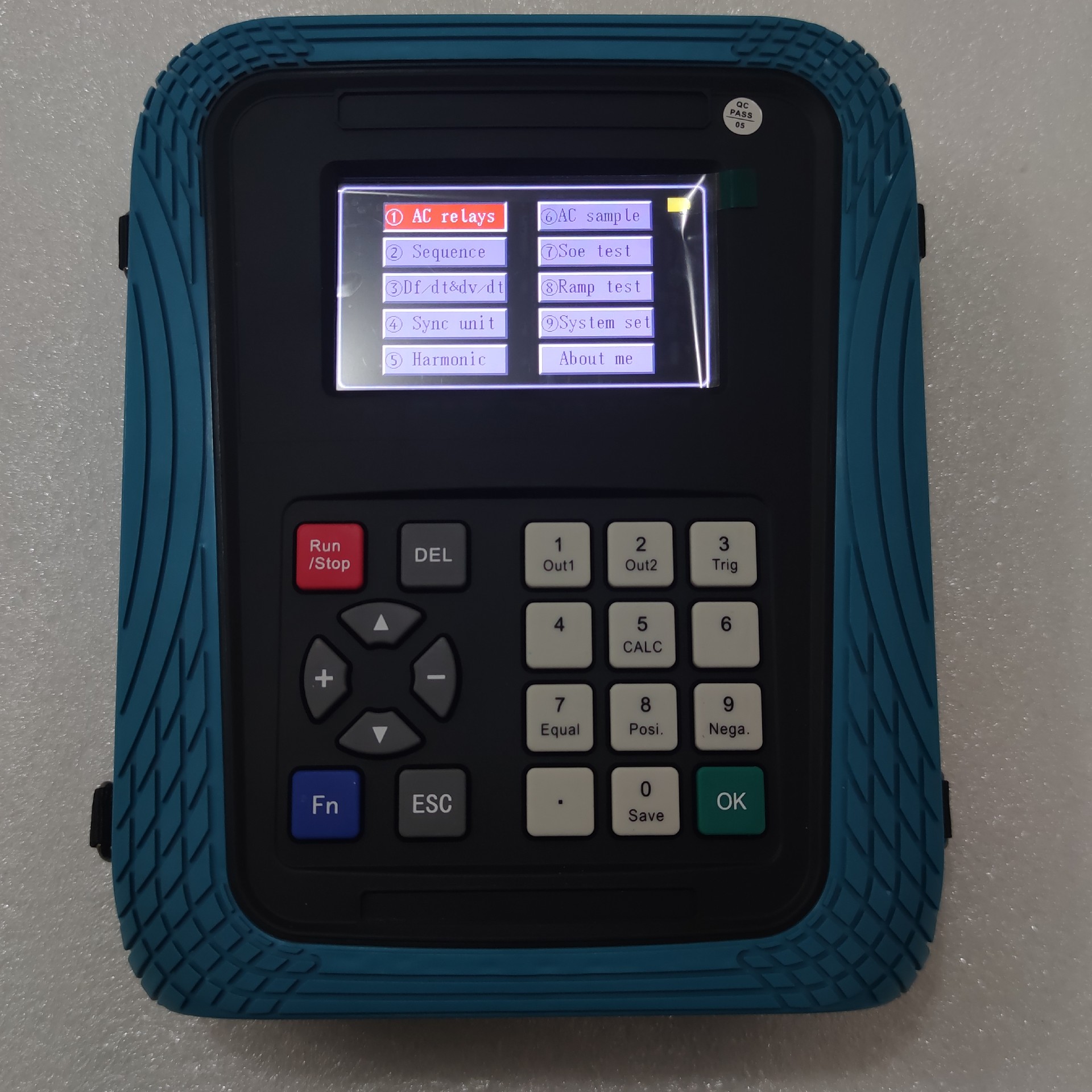
HZJB-1700 Hand-held Three-phase Relay Protection Tester

 中文
中文
 English

 +86-312-6775656
 +86 13731210226
 sales03@bdhuazheng.com
