What is a secondary loop?
In a substation, various types of relay protection devices, measurement and control devices, safety automatic devices, fault recording devices, etc. are collectively referred to as secondary equipment.
The so-called secondary circuit is an electrical circuit formed by connecting these secondary equipment according to certain functional requirements to realize functions such as monitoring, measurement, control, protection, and regulation of the operating conditions of primary system equipment.
Types of secondary circuits (according to the nature of electricity)
To realize their respective functions, the secondary circuits generally need to access the information source that provides the operating status of the primary equipment and the power supply that ensures the operation of the secondary equipment. Therefore, according to the nature of electricity, the secondary circuit can be simply divided into three types: AC sampling circuit, AC power circuit and DC circuit.
AC sampling circuit
The AC sampling loop is a loop related to current transformers and voltage transformers. Its function is to collect the operating parameters of relevant primary equipment (AC signals such as current and voltage) for secondary equipment to realize functions such as monitoring, measurement, control, protection, and regulation of the operating conditions of primary system equipment.
AC power loop
AC power circuit refers to a related circuit that uses alternating current as a power source. Such as: switch energy storage motor power supply, knife gate drive motor power supply, lighting power supply, heater power supply, etc.
DC link
The DC loop refers to the entire loop connected from the positive pole to the negative pole of the DC power supply. The main functions are: 1. Control the operation of circuit breakers, isolating switches and other equipment. The operating circuit of the isolating switch mostly uses AC 380V power supply, and some also use DC power supply.
2. Indicate the operating status, abnormality and fault conditions of primary and secondary equipment. 3. Provide power for the secondary device to work, usually ±220V (or ±110V)
Secondary circuit function
Relay protection circuit and safety automatic device circuit
It is used to automatically, quickly and selectively remove faulty equipment and restore the normal operation of the system as soon as possible to ensure the stability of the power system.
circuit breaker control circuit
It is used for manual control and automatic control of the opening and closing operations of substation circuit breakers.
Isolating switch operation and blocking circuit
For manual control and automatic control of isolating switch operation. Realize the latching between the isolating switch and the circuit breaker to prevent the isolating switch from being pulled closed with load, and the latching between the isolating switch and the grounding switch to prevent the closing of the grounded wire, etc.
signal loop
It is used to indicate the operating status of primary equipment and provide operators with reliable basis for operation, adjustment and troubleshooting.
Measuring loop
It is used to measure electrical parameters and power consumption during the operation of transmission lines and electrical equipment. Usually includes measurements of current, voltage, frequency, power, electric energy, etc.
Synchronous loop
It is used for paralleling of power systems in substations that require frequent disconnection and paralleling. At present, there are fewer and fewer substations that need to be frequently detached and paralleled.
regulating loop
It is used to adjust the working parameters of certain main equipment in real time to ensure the safe, economical and stable operation of the main equipment and power system.
Switching in and out of protection and measurement and control devices
Open in:
1. Analog input
Current transformers and voltage transformers convert small currents and low voltages; protection devices need to collect two analog quantities, current and voltage. The measurement and control device needs to collect not only current and voltage, but also temperature sometimes.
2. Digital quantity (switch quantity) input
It is provided by the auxiliary contacts of various devices through "open/closed" conversion. There are only two states, also called hard contact switches. Protection device: locking reclosing switch, functional pressure plate switch, etc. Measurement and control devices: switches, knife gates, floor knife positions, alarm signals, etc.
Out:
1. Issue operation commands
1.1. Protection device operation commands are issued: (passive, automatic) line protection tripping or reclosing, main transformer protection, bus differential protection tripping, main transformer start air cooling, bus differential action blocking line reclosing, bus differential action blocking Prepare for self-investment, etc.
1.2. Issuance of operating commands from the measurement and control device: (active, artificial) operating commands issued to various electric mechanisms such as circuit breakers, electric knife switches, and floor knives. ("divide", "combine")
2. Signal issued
2.1. The protection device signal is activated: protection action and reclosing action. (Signals such as device power outage, device abnormality/lockout, etc. are faults of the device itself and do not fall within the scope of protection)
2.2. Measurement and control device signal output: The measurement and control device converts the switching signal it collects and then transmits it to the monitoring system through the network. Its function is simply transfer.
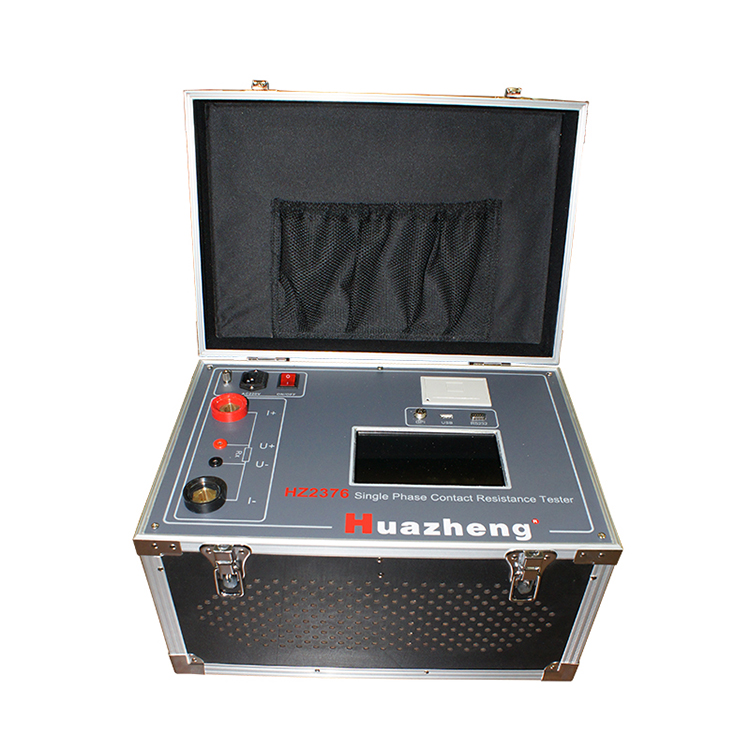
HZ2376 Digital Contact Loop Resistance Tester

 中文
中文
 English

 +86-312-6775656
 +86 13731210226
 sales03@bdhuazheng.com
