Classification of circuit breakers
1
Frame circuit breaker (ACB)
Frame circuit breaker is also called universal circuit breaker. All its parts are installed in an insulated metal frame. It is usually open. It can be equipped with a variety of accessories. It is more convenient to replace contacts and components. It is mostly used in the main switch of the power supply side. . There are several types of overcurrent releases: electromagnetic release, electronic release and intelligent release. The circuit breaker has four stages of protection: long delay, short delay, instantaneous and ground fault. The setting value of each protection is adjusted within a certain range according to its frame level.
Frame circuit breakers are suitable for power distribution networks with AC 50Hz, rated voltages 380V, 660V, and rated currents 200A-6300A. They are mainly used to distribute electric energy and protect lines and power equipment from overload, undervoltage, short circuit, single-phase grounding and other faults. The circuit breaker has a variety of intelligent protection functions and can achieve selective protection. (Click to follow? Top 10 construction technology public accounts) Under normal conditions, it can be used for infrequent line conversion. Circuit breakers below 1250A can be used to protect motors from overload and short circuit in AC 50Hz voltage 380V networks.
Frame-type circuit breakers are also often used in 400V side outlet main switches of transformers, bus tie switches, large-capacity feeder switches and large motor control switches.
2
Plastic case circuit breaker (MCCB)
The plastic case circuit breaker is also called an installation circuit breaker. Its ground terminal outer contact, arc extinguishing chamber, tripper and operating mechanism are all installed in a plastic shell. Auxiliary contacts, undervoltage releases and shunt releases are mostly modular and have very compact structures. Maintenance is generally not considered and they are suitable for use as protection switches for branch circuits.
Molded case circuit breakers usually contain a thermal-magnetic trip unit, while larger models are equipped with solid-state trip sensors. There are two types of overcurrent trippers for plastic case circuit breakers: electromagnetic type and electronic type. Generally, electromagnetic plastic case circuit breakers are non-selective circuit breakers with only two protection modes: long-time delay and instantaneous; electronic plastic case circuit breakers The device has four protection functions: long delay, short delay, instantaneous and ground fault. Some newly launched electronic molded case circuit breakers also have regional selective interlocking functions.
Molded case circuit breakers are generally used for distribution feeder control and protection, low-voltage side outlet main switches of small distribution transformers, power distribution terminal control, and can also be used for power switches of various production machinery.
3
Miniature circuit breaker (MCB)
Miniature circuit breaker is the most widely used terminal protection appliance in building electrical terminal distribution devices. It is used for short circuit, overload, overvoltage and other protection of single-phase and three-phase below 125A, including single-pole 1P, two-pole 2P, three-pole 3P, and four-pole 4P.
Miniature circuit breaker consists of operating mechanism, contacts, protection devices (various releases), arc extinguishing system, etc. Its main contact is closed manually or electrically. After the main contact is closed, the free tripping mechanism locks the main contact in the closing position. The coil of the overcurrent release and the thermal element of the thermal release are connected in series with the main circuit, and the coil of the undervoltage release is connected in parallel with the power supply.
In the electrical design of civil buildings, miniature circuit breakers are mainly used for protection and operation of circuit overload, short circuit, overcurrent, loss of voltage, undervoltage, grounding, leakage, automatic switching of dual power supplies, and infrequent starting of motors.
2
Basic characteristic parameters of circuit breaker
(1) Rated working voltage Ue
Rated operating voltage refers to the nominal voltage of the circuit breaker, which can operate continuously under specified normal use and performance conditions.
Our country stipulates that for voltage levels of 220kV and below, 1.15 times the rated voltage of the system is the maximum working voltage; for voltage levels 330kV and above, 1.1 times the rated voltage is the maximum working voltage. The circuit breaker can maintain insulation under the highest operating voltage of the system and can be closed and opened according to specified conditions.
(2) Rated current In
The rated current refers to the current that the tripper can pass for a long time when the ambient temperature is below 40°C. For a circuit breaker with an adjustable release, it is the maximum current that the release can pass for a long time.
When the ambient temperature exceeds 40℃ but not higher than 60℃, long-term operation with reduced load is allowed.
(3) Overload release current setting value Ir
If the current exceeds the tripper current setting value Ir, the circuit breaker will trip with delay. It also represents the maximum current that the circuit breaker can handle without tripping. This value must be greater than the maximum load current Ib, but less than the maximum current Iz allowed by the line.
Thermal trip relay Ir can usually be adjusted within the range of 0.7~1.0In, but if electronic equipment is used, the adjustment range will be larger, usually 0.4~1.0In. For circuit breakers equipped with non-adjustable overcurrent breakout relays, Ir=In.
(4) Short-circuit release current setting value Im
The short-circuit trip relay (instantaneous or short-time delay) is used to trip the circuit breaker quickly when a high fault current value occurs, and its trip threshold is Im.
(5) Rated short-time withstand current Icw
Refers to the current value allowed to pass within the agreed time. This current value passes through the conductor within the agreed time and will not cause damage to the conductor due to overheating.
(6) Breaking ability
The breaking capacity of a circuit breaker refers to the circuit breaker's ability to safely cut off fault current. It is not necessarily related to its rated current. Currently, there are specifications such as 36KA and 50KA. It is generally divided into ultimate short-circuit breaking capacity Icu and operating short-circuit breaking capacity Ics.
3
General principles for circuit breaker selection
First, select the type and number of poles of the circuit breaker according to the purpose; select the rated current of the circuit breaker according to the maximum operating current; select the type of tripper, type and specification of accessories according to needs. Specific requirements are as follows.
1) The rated operating voltage of the circuit breaker ≥ the rated voltage of the line.
2) The rated short-circuit breaking capacity of the circuit breaker ≥ the calculated load current of the line.
3) The rated short-circuit breaking capacity of the circuit breaker ≥ the maximum short-circuit current that may occur in the line (generally calculated based on the effective value).
4) The single-phase to ground short-circuit current at the end of the line is ≥1.25 times the instantaneous (or short-delay) tripping setting current of the circuit breaker.
5) The rated voltage of the circuit breaker undervoltage release is equal to the rated voltage of the line.
6) The rated voltage of the shunt release of the circuit breaker is equal to the control power supply voltage.
7) The rated operating voltage of the electric transmission mechanism is equal to the control power supply voltage.
8) When the circuit breaker is used in lighting circuits, the instantaneous setting current of the electromagnetic release is generally 6 times the load current.
9) When a circuit breaker is used as the short-circuit protection of a single motor, the setting current of the instantaneous release is 1.35 times (DW series circuit breakers) or 1.7 times (DZ series circuit breakers) of the motor starting current.
10) When a circuit breaker is used as short-circuit protection for multiple motors, the setting current of the instantaneous release is 1.3 times the maximum starting current of one motor plus the operating current of the remaining motors.
11) When using a circuit breaker as the main switch on the low-voltage side of the distribution transformer, its breaking capacity should be greater than the short-circuit current value on the low-voltage side of the transformer. The rated current of the tripper should not be less than the rated current of the transformer. The set current of the short-circuit protection is generally 6-10 times the rated current; the setting current of the overload protection is equal to the rated current of the transformer.
12) After initially selecting the type and level of the circuit breaker, it must be coordinated with the protection characteristics of the upper and lower level switches to avoid over-level tripping and expand the scope of the accident.
4
Circuit breaker selectivity
Circuit breakers used in power distribution systems can be divided into two categories according to their protection performance: selective and non-selective. Selective low-voltage circuit breakers are available in two-stage protection and three-stage protection. The instantaneous characteristics and short-delay characteristics are suitable for short-circuit action, while the long-delay characteristics are suitable for overload protection. Non-selective circuit breakers are generally instantaneous and are only used for short-circuit protection. Some are long-delay actions and are only used for overload protection. In the power distribution system, if the upper-level circuit breaker uses a selective circuit breaker and the next-level circuit breaker uses a non-selective circuit breaker or a selective circuit breaker, the delayed action or delayed action of the short-delay release is mainly used. The action time is different to obtain selectivity. When passing the delayed action of the upper-level circuit breaker, please pay attention to the following issues.
1) Regardless of whether the next level is a selective circuit breaker or a non-selective circuit breaker, the setting current of the instantaneous overcurrent release of the upper level circuit breaker shall generally not be less than 1.1 times the maximum three-phase short-circuit current at the outlet end of the next level circuit breaker. .
2) If the next stage is a non-selective circuit breaker, in order to prevent short-circuit current from occurring in the circuit protected by the next stage circuit breaker, due to insufficient instantaneous action sensitivity of this stage, the short-delay overcurrent release of the previous stage will first action to make it lose its selectivity. Generally, the setting current of the short-time overcurrent release of the upper-level circuit breaker is not less than 1.2 times of the instantaneous over-current release of the next level.
3) If the next level is also a selective circuit breaker, in order to ensure selectivity, the short delay action time of the upper level circuit breaker is at least 0.1s longer than the short delay action time of the next level circuit breaker. Generally speaking, to ensure selective operation between the upper and lower low-voltage circuit breakers, the upper-level circuit breaker should choose an over-current release with a short delay, and its operating current should be larger than the next-level over-current release. For operating currents above one level, at least the operating current Iop.1 of the upper level is not less than 1.2 times the operating current Iop.2 of the next level, that is, Iop1≥1.2Iop.2.
5
Cascade protection of circuit breakers
In the design of the power distribution system, the selective coordination between the upper and lower stages of the circuit breaker must be "selective, rapid and sensitive".
The selectivity is related to the cooperation between the upper and lower circuit breakers, while the speed and sensitivity are related to the characteristics of the protective appliance itself and the line operation mode respectively.
If the upper and lower circuit breakers cooperate properly, the faulty circuit can be selectively cut off to ensure that other fault-free circuits in the power distribution system continue to operate normally. On the contrary, it affects the reliability of the power distribution system.
Cascade protection is a specific application of the current-limiting characteristics of circuit breakers. Its main principle is to utilize the current-limiting effect of the upper-level circuit breaker. When selecting a lower-level circuit breaker, a circuit breaker with a lower breaking capacity can be selected to reduce costs and save expenses. Purpose. The upper-level current-limiting circuit breaker QF1 can break the maximum expected short-circuit current at its installation location. Since the upper-level and lower-level circuit breakers in the power distribution system are installed in series, when a short circuit occurs at the outlet of the lower-level circuit breaker QF2, the short-circuit current will be due to the upper-level circuit breaker. The current limiting effect of circuit breaker QF1 makes its actual value much smaller than the expected short-circuit current there. That is to say, the breaking capacity of lower-level circuit breaker QF2 is greatly enhanced with the help of upper-level circuit breaker QF1, exceeding its rated breaking capacity. This kind of cascade protection also has certain conditions. For example, the adjacent circuit cannot have important loads (because once QF1 trips, the QF3 circuit will also lose power). At the same time, the instantaneous setting value of QF1 and the instantaneous setting value of QF2 must also match appropriately. Cascading data can only be measured experimentally, and the matching selection of upper and lower circuit breakers can only be determined by the circuit breaker manufacturer.
6
Circuit breaker sensitivity
In order to ensure that the instantaneous or short-time overcurrent release of the circuit breaker can operate reliably when the slightest short-circuit fault occurs within its protection range under the minimum operating mode of the system. The sensitivity of circuit breaker protection must meet the "Low Voltage Distribution Design Code" (CB50054-95) which stipulates that the sensitivity should not be less than 1.3, that is, Sp=lk.min/Iop≥1.3. In the formula, lop is the operating current of the instantaneous or short-time overcurrent release, Ik.Min is the single-phase short-circuit current or two-phase short-circuit current at the end of the line protected by the circuit breaker in the minimum operating mode of the system, Sp is the circuit breaker sensitivity.
When selecting a circuit breaker, attention should also be paid to verifying its sensitivity. For selective circuit breakers with both short-delay and instantaneous overcurrent releases, only the action sensitivity of the short-delay overcurrent release needs to be verified. , there is no need to verify the sensitivity of the instantaneous overcurrent release action.
7
Circuit breaker tripper selection and setting
(1) Setting of the operating current of the instantaneous overcurrent release
Among the objects protected by the circuit breaker, there are certain electrical equipment. During the startup process, these electrical equipment will generate high peak currents several times their rated current in a short period of time, causing the circuit breaker to withstand a large amount of power in a short period of time. of peak current. The operating current lop(o) of the instantaneous overcurrent release must avoid the peak current Ipk of the line, that is, Iop(o)≥Krel·Ipk. In the formula, Krel is the reliability coefficient. When selecting a circuit breaker, care should be taken to ensure that the set current of the instantaneous overcurrent release of the circuit breaker avoids the peak current to avoid malfunction of the circuit breaker.
(2) Setting of the action current and action time of the short-time overcurrent release
The operating current lop(s) of the short-time overcurrent release should also avoid the peak current Ipk of the line, that is, Iop(s)≥Krel·Ipk. In the formula, Krel is the reliability coefficient. The action time of short-time overcurrent release is generally divided into three types: 0.2s, 0.4s and 0.6s, which are determined according to the protection selectivity of the front and rear protection devices. The action time of the previous level of protection should be longer than that of the latter level of protection. The action time is one step longer.
(3) Setting of the action current and action time of the long-delay overcurrent release
The long-time overcurrent release is mainly used to protect overload, so its operating current Iop(l) only needs to avoid the maximum load current of the line, which is the calculated current I30, that is, Iop(l) ≥ Krel·I30. In the formula, Krel is the reliability coefficient. The action time of the long-delay overcurrent release should avoid the duration of allowed short-term overload, so as not to cause malfunction of the low-voltage circuit breaker.
(4) Cooperation requirements between the operating current of the overcurrent release and the protected circuit
In order to prevent the insulated cable from overheating, damage or even fire due to overload or short circuit, and the circuit breaker does not trip, the operating current lop of the circuit breaker overcurrent release should meet the requirements of the formula, lop≤Kol· Ial. In the formula, Ial is the allowable carrying capacity of insulated cables; Kol is the allowable short-time overload coefficient of insulated cables. For instantaneous and short-time overcurrent releases, it is generally taken as 4.5; for long-time overcurrent releases For short-circuit protection, it takes 1.1, and for overload protection only, it takes 1. If the above coordination requirements are not met, the tripper operating current should be changed, or the cross-sectional area of the wire or cable should be appropriately thickened.
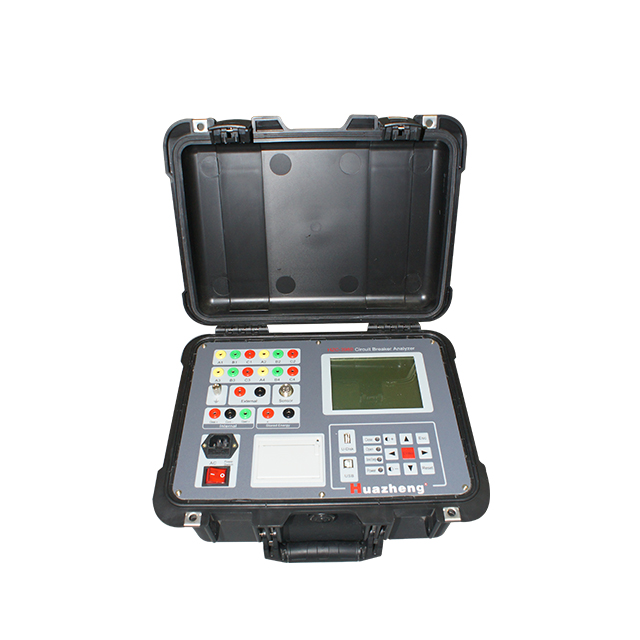
HZC-3980 Circuit Breaker Analyzer

 中文
中文
 English

 +86-312-6775656
 +86 13731210226
 sales03@bdhuazheng.com
