0 1
Classification of secondary circuits
There are different types and categories of electrical secondary circuits, but generally they can be divided into three types.
The first type is mainly classified according to the purpose of the electrical secondary circuit, which can be divided into principle-based wiring circuits, expanded wiring circuits and installation-based wiring circuits.
The second classification method is based on functional meters, which can be divided into signal loops, control loops, protection loops and measurement loops.
The third type is also analyzed according to the nature of the power supply. According to the difference in current used, it can be divided into DC voltage loop and AC voltage loop.
This classification is mainly based on the different properties of the electrical secondary circuit. When performing fault analysis, the type of the faulty electrical secondary circuit also needs to be taken into consideration.
0 2
Troubleshooting of secondary circuit faults
When a safety failure occurs in the secondary circuit, if no timely troubleshooting is carried out, safety accidents will occur. To troubleshoot the fault, first of all, it is necessary to send corresponding records to the fault recorder of the transformer unit. If there is no record, the phase angle value, differential current, etc. of the unit need to be retrieved for data sampling. If no abnormality is found after on-site measurement, the startup record in the obstacle recorder should be retrieved. The protection device of the generator-transformer unit is a complete set of protection devices, which can carry out corresponding recording through the corresponding wave recording function, such as differential current values, analog sampling bits, etc.
Analyzing the wave recording of the generator-transformer group, if distortion is found in the U-phase current, and at the same time, the current waveform of the corresponding neutral point appears normal. If a secondary differential current is found in the II-phase, then it can be concluded that the fault is not In case of a primary equipment failure, it can be determined that the fault is caused by a problem in the secondary circuit or protection device. During the inspection, the unit should be shut down. After inspection, if it is found that the group protection device can collect waves normally, you can know that the waveform of the wave recording device is normal.
After completing the judgment, conduct an effective inspection of the wiring terminals. During the inspection process, check the wiring of the current transformer. If the color of the wiring screws changes, you need to remove the wiring. At the same time, you should also open Check the insulation tape to determine whether the roots are broken.
0 3
Open circuit method for analyzing secondary circuit faults
The open-circuit method is often used in setting up obstacles on DC circuits. This method is simple and can accurately find the location of the circuit. When using the open circuit method, you first need to open the entire line one by one to find the line where the fault occurs. Then use a voltage pen to monitor the voltage to see if the line voltage is within the normal voltage range. Use the section-by-section detection method to find the fault line. For specific locations, this method is relatively simple, but its scope of application is relatively small. Only the secondary circuit of the DC line is more suitable for this method.
0 4
Secondary circuit fault analysis-substitution method
Some electronic components are used in the electrical secondary circuit, and these components are widely used in current industrial power. However, if these components fail, there will be certain difficulties in maintenance, and It is very difficult to check the fault of electronic components, and at this time, if the substitution method is used, this difficulty can be effectively reduced. The operating principle of the substitution method is to use good electronic components to replace electronic components of the same model and function in the electrical circuit. If there is still a fault in the electrical circuit after replacement, it means that the fault is not caused by this electronic component. An electronic component that can continue another function until a faulty electronic component occurs in the electrical secondary circuit.
05 Secondary circuit fault analysis-potentiometric method
When using the substitution method to find faulty electrical components, the model and type of the electronic component are often known. However, if the model of the electronic component is not known, there will be certain difficulties in using the substitution method. At this time, the potentiometric method can be used to measure the potential of the electrical secondary circuit using some auxiliary equipment. If the measured potential is abnormal, the location of the fault can be determined at this time.
0 6 Secondary circuit fault analysis-amperometric method
During the Tunli production process, if personnel operate the relay protector improperly, it is easy to cause the circuit breaker in the electrical secondary circuit to be disconnected. In order to ensure the circuit safety of the secondary circuit, it is necessary to perform secondary circuit breaker at this time. The circuit lines are monitored. Using the method of current measurement, we can effectively detect whether there is a short circuit problem in the electrical secondary circuit. If the measured current is not within the normal range during measurement, we can determine that there is a fault in the circuit.
0 7 Secondary circuit fault analysis-combination of open circuit method and resistance method
This method is mainly to monitor whether there is a short circuit problem in the electrical secondary circuit. This method adopts the principle of combining the two methods, and the measured results are more stable and accurate. When measuring a circuit short circuit, you can use a multimeter and other auxiliary equipment to measure the resistance values at both ends. When the measured resistance value is less than the minimum standard resistance value, it indicates that a short circuit fault has occurred in the circuit.
0 8 How to deal with secondary circuit faults: check the tripping and closing position of the switch
The indicator lights of the switch control tripping and closing positions mainly indicate the actual position of the circuit breaker and are controlled by relay contacts at the tripping and closing positions in the circuit. In the secondary circuit, when the relay contacts operate abnormally, the indicator lights of the switch tripping and closing cannot reflect the correct position of the circuit breaker. The indicator lights between tripping and closing should be controlled by the circuit breaker switch contacts in order to correctly reflect Circuit breaker location. By checking the wiring of the secondary circuit and checking the as-built data, effective solutions can be derived. After rectification, the defects of secondary passability will be eliminated.
0 9
How to deal with secondary circuit faults-finding DC ground faults
Standardizing the management of DC circuits and effectively performing insulation inspections can greatly reduce the probability of line overstepping and tripping, thereby fully ensuring the safety, reliability and stability of the power system operation. An effective method to find a DC ground fault is the wire pull test. That is to say, perform a power outage inspection on each DC branch separately. If the DC grounding phenomenon disappears, it means that this branch has a grounding phenomenon. Then, after layer-by-layer decomposition and section-by-section inspection, the grounding point is finally located in a simple loop. , further limit it to a few wires or terminals, and after careful observation and repeated touching, find the fault source of the ground point.
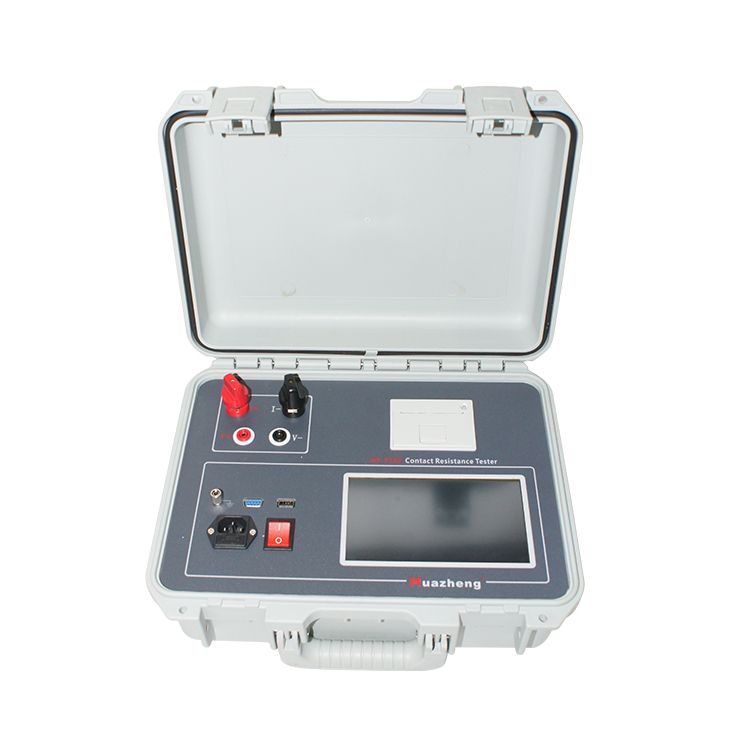
HZ-5100 Contact Resistance Tester

 中文
中文
 English

 +86-312-6775656
 +86 13731210226
 sales03@bdhuazheng.com
