1. Abnormal noise occurs inside the transformer.
Abnormal noises inside the transformer may be due to the following reasons:
a. Severe overload causes a heavy "buzzing" sound inside the transformer;
b. Due to poor internal contact or breakdown points, "squeaking" or "crackling" discharge sounds occur inside the transformer;
c. Because some parts of the connecting shaft bolt of the transformer top cover are loose, the transformer core is not clamped, causing the silicon steel sheet to vibrate and emitting strong noise;
d. When there is a grounding or short-circuit fault in the power grid, a large current flows through the windings and strong noise is emitted;
e. When the transformer is connected to large power equipment or equipment that can generate harmonic currents, the operation of the equipment may cause the transformer to emit a "wow" sound; f. Due to resonance in the iron core,
The transformer produces coarse and fine noise;
g. If the primary side voltage of the transformer is too high or the current is too high, abnormal noise will occur;
h. Due to overvoltage, discharge of the winding or lead wire to the shell, or disconnection of the core ground wire, causing the iron core to discharge to the shell, the transformer will make a discharge sound.
Emergency measures: When abnormal noise is found from the transformer, the possible causes should be determined based on the above analysis, and targeted measures should be taken.
Emergency measures. If the abnormal sound inside the transformer is caused by loose parts or breakdown of winding wires, the power should be cut off immediately to avoid further expansion of the accident.
2. The oil level of the transformer is too high or too low.
Generally, changes in oil temperature can change the oil level. As the oil temperature changes, the oil level also changes within a certain range. However, under abnormal circumstances, abnormal changes in oil level may also occur due to oil leakage, water leakage and other faults and other accidents. Secondly, changes in oil temperature are related to load conditions, ambient temperature and other conditions. When the oil level changes are inconsistent with these factors, it may be a false oil level. Reasons for false oil level:
a. The oil level pipe is clogged;
b. The exhaust hole of the explosion-proof pipe is blocked.
In addition, if the oil level is too high, it will cause oil spillage; if the oil level is too low, the internal lead wires and even coils of the transformer may be exposed, causing internal discharge.
Treatment methods and emergency measures: If there is gas relay protection, remove its tripping circuit to prevent accidental tripping. Electrical equipment operators on duty should always check the oil level gauge indication. If the oil level is too high, they can drain the oil appropriately; if the oil level is too low, they should replenish the oil in time. If it is caused by oil leakage from the transformer, power outage maintenance and other emergency measures should be taken. When abnormal fuel injection is found in the oil pillow or explosion-proof pipe, the power supply to the transformer should be cut off immediately to prevent the expansion of faults and accidents.
3. The quality of the transformer oil deteriorates or the oil temperature suddenly rises.
When in working condition, the main functions of transformer oil are cooling and insulation. When overheated for a long time or water enters the shell, moisture will be absorbed, which will cause the oil quality to deteriorate. Observing the oil mark will reveal that the oil color is abnormally deepened or blackened; after sampling and analysis, it can be found that the oil contains carbon particles and water, the acid value is increased, the flash point is reduced, and the insulation strength is reduced. In this case, breakdown discharge can easily occur between the winding and the casing, causing serious accidents. When the transformer is operating normally, if the oil temperature suddenly rises, it is often the cause of overheating inside the transformer. The iron core catches fire, the winding turns are short-circuited, the internal screws are loose, the cooling device fails, and the transformer is severely overloaded, which may cause the oil temperature to rise suddenly.
4. Solutions and emergency measures.
a. If it is found that the oil color is abnormally deepened or blackened, the insulating oil needs to be regenerated and filtered;
b. If the oil temperature suddenly rises due to load factors, the load can be appropriately reduced or adjusted;
c. If the oil temperature suddenly rises due to other abnormal conditions, the power should be cut off immediately and the converter should be comprehensively inspected.
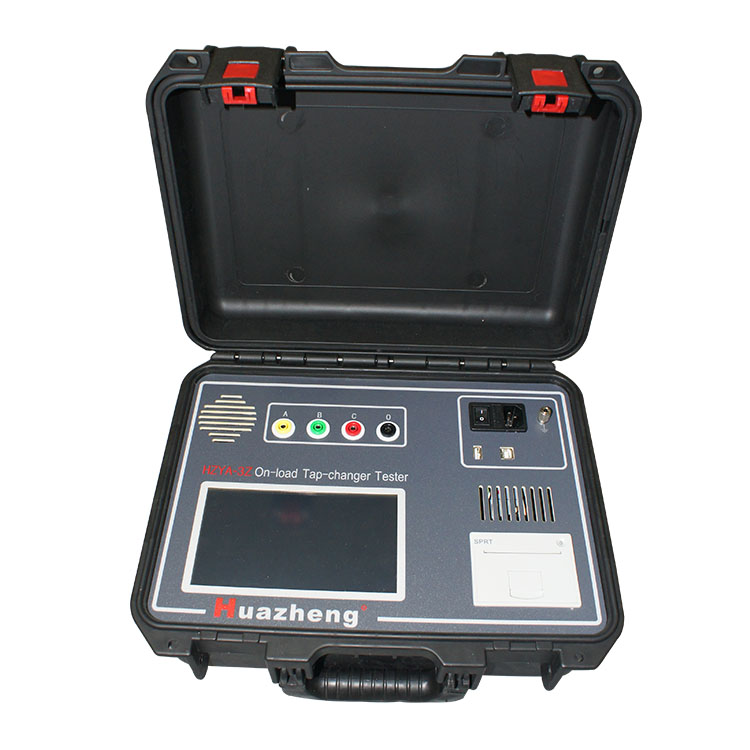
HZYA-3Z Transformer On-load Tap-changer Tester

 中文
中文
 English

 +86-312-6775656
 +86 13731210226
 sales03@bdhuazheng.com
