Working principle of leakage switch
During normal operation, there is no leakage current in the circuit except the operating current through the leakage protector. At this time, the currents flowing through the zero-sequence transformer (detection transformer) are equal in magnitude and opposite in direction, and the sum is zero. The magnetic flux is induced in the transformer core. Also equal to zero, the secondary winding has no output, the automatic switch remains on, and the leakage protector is operating normally. When a leakage occurs between the protected electrical appliance and the circuit or someone gets an electric shock, there will be a ground fault current, causing the current vector sum flowing through the detection transformer to be non-zero. A magnetic flux will be induced in the transformer core, and its secondary winding will have an induction. The current is generated and output after amplification, causing the leakage release to operate and push the automatic switch to trip to achieve the purpose of leakage protection. The short-circuit protection and overload protection functions of the leakage switch are the same as those of the air switch, so they will not be discussed here.
Causes and solutions of leakage switch tripping failures
Type 1: The rated current of the leakage switch is less than the actual operating current of the line, and an overload protection trip occurs.
Fault phenomenon: When the electrical load is large, the leakage switch trips.
Cause of the fault: After analysis, the wiring of the line is correct. ① The load calculation error leads to the wrong selection of the leakage switch. The rated current of the switch is smaller than the actual working current of the line, causing the leakage switch to trip due to overload fault. ② The load calculation is correct, the leakage switch is used correctly, and the artificial use of the leakage switch causes a large amount of damage. Power electrical equipment causes the overload protection of the leakage switch to trip.
Solution: ① Replace the leakage switch with a larger maximum allowable operating current; ② Inform electrical users that the use of high-power electrical equipment is prohibited.
Type 2: The insulation of the electrical equipment itself is damaged and causes leakage (that is, the N line and PE line in the equipment are short-circuited).
Fault phenomenon: When the socket circuit uses electricity, the leakage switch of the socket circuit trips.
Cause of the fault: After analysis, the line wiring was correct, and the load calculation matched the leakage switch. Therefore, it was determined that the insulation of the electrical equipment itself was damaged and caused leakage (that is, the N line and PE line in the equipment were short-circuited).
Solution: Replace or repair electrical equipment to ensure good insulation.
Type 3: The insulation strength is reduced due to moisture in the line or the leakage switch fails to trip due to short circuit in the line.
Fault phenomenon: When no electricity is used, the leakage switch of the socket circuit trips.
Cause of failure: After analysis, ① The insulation strength of the line is reduced due to moisture, causing the leakage current to exceed the allowable leakage current value of the leakage switch. ② Caused by line short circuit.
Solution: ① Dry the circuit to improve the insulation strength. ② Check the circuit if it is caused by a short circuit and eliminate the short circuit fault.
Type 4: Someone gets an electric shock and the leakage switch of the socket circuit trips.
Fault phenomenon: The leakage switch of the socket circuit suddenly tripped.
Cause of failure: Someone received an electric shock.
Solution: Promote and educate users on the safe use of electricity to avoid electric shock accidents. If someone is found to have received an electric shock, the injured should be rescued in time.
Type 5: The employee’s wiring is incorrect and the N line is connected to the PE line in the lighting circuit.
Fault phenomenon: The socket circuit can use electricity normally, but when the lighting circuit uses electricity, the total leakage switch in AL1 trips.
Cause of the fault: After analysis, the line wiring was incorrect, and the N line in the lighting circuit was mistakenly connected to the PE line.
Solution: Change the wiring and connect the PE line in the lighting circuit to the N line.
Type 6: The employee’s wiring is incorrect, and the N line and PE line in the socket box are connected incorrectly.
Fault phenomenon: The lighting circuit can use electricity normally, but when the socket circuit uses electricity, the socket leakage switch in ALY trips, and sometimes the main leakage switch in AL1 also trips.
Cause of the fault: After analysis, the line wiring was incorrect, and the N line and PE line in the socket box were connected incorrectly.
Solution: Change the wiring and swap the N line and PE line in the socket box.
Type 7: The employee’s wiring is incorrect, and the N line and PE line are mixed in the AL1 box.
Fault phenomenon: When the socket circuit or lighting circuit uses electricity, the main leakage switch in AL1 trips.
Cause of the fault: After analysis, the line wiring was incorrect, and the N line and PE line in the AL1 box were mixed.
Solution: At the load end of the total leakage switch of the AL1 box, swap the N line and PE line.
Leakage switches can not only protect circuits from overloads and short circuits, but can also be used as leakage protection devices. They play an important role in our office electricity consumption and protect the safety of our electricity users. Through the introduction of the principle of leakage switches and the analysis of fault tripping, this article hopes to guide electrical workers to correctly use leakage switches, quickly and accurately find the cause after the switch fails to trip, and handle the fault in time to restore power supply.
Use a multimeter to quickly check leakage points
1. First disconnect the main isolating switch of the user's power incoming line and turn off all the user's electrical loads, such as unplugging the refrigerator, turning off the water pump switch, etc.
2. Place the digital multimeter on the 200M ohm range, place one test lead on one of the two outlet wires on the load side, and touch the other test lead to the wall, preferably to the ground wire or a temporary Ground wire. After the number displayed on the multimeter stabilizes, what is read is the insulation resistance value of the main line. If the insulation resistance value is less than 0.5 megohm, then there is a problem with the main line. If the insulation resistance is above 0.5 megohm, it can be ruled out. There is a problem with the main line. Use the same method to measure the other wire and check the value to see if there is a problem with the main line.
3. Check the insulation resistance value of the branch circuit and each electrical appliance, and use the same method to detect them one by one until the fault point is found.
Changhui Instrument http://yunrun.com.cn/
Operation precautions
1. When using the 200M ohm block of the multimeter, be careful not to touch the metal part of the test lead with your hands during measurement, as this will cause inaccurate readings.
2. When measuring each electrical equipment, be sure to discharge it first to prevent the capacitive current in the electrical equipment from hurting people.
This method is a safer way to find the fault point when there is no power. This method is also suitable for power users and factory buildings to find leakage. However, when searching, not only the power incoming line must be disconnected, but also the neutral line should be disconnected to avoid electric shock accidents.
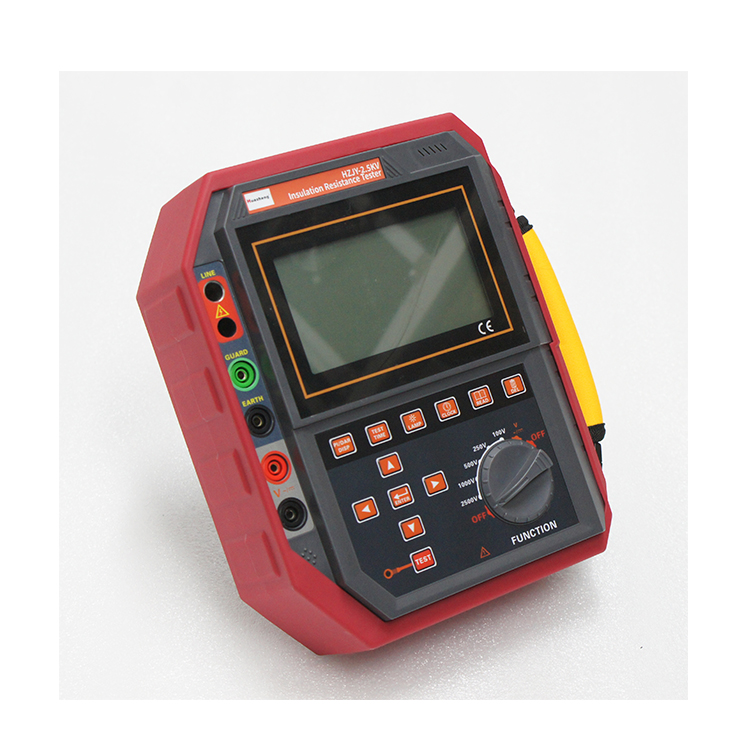
HZJY-2.5KV Insulation Resistance Tester

 中文
中文
 English

 +86-312-6775656
 +86 13731210226
 sales03@bdhuazheng.com
