Chapter 3: Identification, handling and prevention of short-circuit damage accidents at close outlet of transformer
With the continuous development of the national economy and industrial and agricultural production, the installed capacity of the power system is increasing day by day, and the short-circuit capacity and short-circuit current in the system are greatly increased. The power transformers operating in the system will inevitably encounter various types of exports at close range. Short-circuit accident, the short-circuit current of the accident flows through the transformer, causing the transformer to suddenly change from a normal load current to a short-circuit current that is dozens of times the load current. During the transient process, mechanical stress that is hundreds of times greater than normal operation is often generated and the transformer is damaged. The transformer is damaged; a short circuit at the close outlet of the transformer causes winding deformation, insulation damage, coil burnout, and even core damage and fuel tank deformation, which generally causes the transformer to trip and stop operating, affecting the power supply to the society. The transformer itself needs to be repaired immediately, causing The losses are huge.
1. The harm caused by outlet short-circuit fault to power transformers
Power transformers rely on insulated high-voltage conductors, busbar conductors or high-voltage cables, and are connected to generator sets, power systems, distribution busbars and user distribution lines through circuit breakers. In actual on-site operations, secondary power transformers are often encountered. Various short-circuit faults that occur on one side of the winding reduce the loop impedance significantly and generate a large short-circuit current in the primary and secondary windings. The size of this current is often related to a variety of factors, such as: the location of the short-circuit, and the moment when the short-circuit occurs. phase, short-circuit impedance and system operation mode during short-circuit, etc., and increase with the increase of system short-circuit capacity and single transformer capacity. Due to the inherent action time of circuit breakers and related automatic devices, short-circuit fault points are impossible Zero time cut-off, the transformer will inevitably be impacted by short-circuit current. Usually the short-circuit current is more than ten to dozens of times the rated operating current. The electromotive force and heat generated by such a large short-circuit current will endanger the dynamic and thermal stability of the power transformer. performance, causing it to be seriously damaged and affecting the normal operation of the power transformer.
1. The harm caused by the electric power generated by the outlet short circuit to the power transformer
During the operation of the power transformer, current passes through the winding. Due to the existence of current and leakage magnetic field, electrodynamic force will be generated on the winding. This electromotive force is proportional to the leakage magnetic flux density and the size of the passing current, that is, proportional to the square of the passing current. When the power transformer is operating normally, the electric force acting on the conductor is very small. However, when there is a sudden short circuit, the short-circuit current of ten to dozens of times will generate the electric force of hundreds to thousands of times of the rated hour, which may cause damage to the windings of the power transformer. Unstable deformation, insulation damage, short circuit between turns (between cakes), and thus damage to the transformer. The destructive effects of electric power on a power transformer are often manifested in the following: deformation and damage of the winding's pressing parts. In severe cases, the steel support plate of the upper clamp is bent, the pressure nail support plate falls off, the pressure nail bends and displaces, and the end paper (wood) The pressure ring is broken, the lead wooden bracket is broken and damaged, etc., and the winding is deformed, the inner winding is partially bent, and the outer winding is pulled loose or broken; the winding wire cake is deformed along the axial direction, and the oil gap between the wire cakes becomes smaller, the pads will shift, destroying the insulation between turns (cakes), causing insulation breakdown.
In addition, power transformers have withstood outlet short-circuit impacts many times. Even if there is no insulation breakdown, causing the transformer to trip, its windings have experienced multiple cumulative deformations. These deformations reduce the mechanical and dielectric strength of the windings. Or overvoltage impact, or even under the action of normal ferromagnetic resonance overvoltage, may cause internal insulation breakdown and cause damage to the transformer.
2. The harm to power transformers caused by overheating caused by outlet short circuit
The resistance loss of the power transformer winding is proportional to the square of the current and the time of the current, that is, W = I2Rt. During the short circuit process, dozens of times the rated short-circuit current will increase its resistance loss hundreds of times. This is the core and leakage losses will also increase significantly; these losses will be converted into heat energy to increase the temperature of the winding. Since the short-circuit time is very short, generally only a few seconds, IEC76-5 stipulates t=2s, the heat energy generated cannot be released in time. External diffusion will all be used to increase the winding temperature; according to the national standard "Power Transformer Part 5: Ability to Withstand Short Circuit", when designing a power transformer, the allowable temperature of the winding copper wire is 2500C (2), and the design starting temperature is 1050C , at this time, as long as the transformer protection device and circuit breaker can operate reliably and timely, the duration of the short-circuit current will generally not exceed the thermal stability requirements of the transformer. Therefore, the possibility of thermal stability damage of the power transformer is also small. Only in the continued If the electrical protection device refuses to operate and the short-circuit current passes through the winding for a long time, it is possible to destroy the thermal stability of the power transformer and burn out the transformer.
The power transformer will be damaged to varying degrees under the combined action of overheating and electrodynamic force caused by the huge short-circuit current when the outlet is short-circuited. Relevant technical personnel need to focus on the nature of the short-circuit fault, the size of the short-circuit current, the distance between the short-circuit point and the outlet, and The operation status of transformer relay protection and automatic devices, oil chromatography analysis of flammability characteristic gas content, and the transformer after tripping must be comprehensively analyzed and judged based on electrical test parameters such as DC resistance, winding deformation, no-load loss, etc., based on Determine the extent of damage, quickly determine whether the transformer can continue to operate, and formulate a repair plan.
2. Inspection tests and requirements for power transformers after experiencing outlet short circuit
Once an outlet short-circuit occurs in a power transformer during actual operation, especially a short-circuit fault within an electrical distance of less than 2km, whether it causes the transformer to trip or not, corresponding inspections and tests must be carried out. If necessary, the power must be cut off to conduct a comprehensive electrical test. And lift the bell jar for internal inspection based on the test results.
1. Appearance inspection. Carefully check whether there are any obvious unevenness in the transformer shell, whether there is any oil leakage from the box weld, check the operation of the pressure release device, check whether the gas relay operates or sends a signal, and whether there is a collection of flammable gas. Check the power transformer that is still running. Pay attention to identify whether the sound is abnormal. Normal operation will emit a continuous, uniform, slight "buzzing" sound. If the sound is uneven or has special sounds, it is considered abnormal, such as the sound of a welding machine, crackling discharge sounds, etc.
2. Take an oil sample for gas chromatography analysis. Transformer oil mainly plays the role of insulation and cooling in power transformers. However, once overheating and discharge faults occur inside the transformer, the transformer oil and other insulating materials will chemically decompose, producing specific hydrocarbon gases, H2, and carbon oxides. etc., the quantity and gas production rate of these gases are often closely related to the fault temperature; as the fault temperature increases, the hydrocarbon gases with the largest gas production are CH4, C2H6, C2H4, and C2H2. Measuring the composition and content of the characteristic gas (3) to analyze the temperature of the internal heating or discharge point of the power transformer can determine whether the power transformer has been damaged after experiencing an outlet short circuit; an outlet short circuit will cause an inter-turn (between-cake) short circuit of the winding. It is an instant high-energy power frequency continuous current discharge, sometimes involving solid insulation; therefore, the change in C2H2 content is often large, followed by C2H4, C2H6, CH4, etc. If it is exposed to short-circuit damage for a long time, the content of CO and CO2 will also increase significantly.
3. DC resistance measurement. The DC resistance of the power transformer winding is basically balanced in the three-phase values when it leaves the factory and is in good condition. Measuring the DC resistance can conveniently and effectively assess the connection between the winding longitudinal insulation and the loop, and can detect short circuits between turns (cakes) caused by short circuits at the outlet of the power transformer. , Winding strand breakage and other faults. If the resistance of a certain phase increases abnormally, the phase winding may have strand breakage, indicating that the power transformer has suffered severe impact damage and cannot be put into operation.
Dielectric loss and capacitance measurements of windings. When local mechanical deformation occurs in a power transformer, the relative positions between its windings and between the core and the shell will change, and its capacitance will also change accordingly; although the preventive test regulations for power equipment only measure the dielectric loss value from the perspective of insulation. However, severe winding deformation will cause significant changes in capacitance. Therefore, when checking whether a power transformer has undergone severe deformation after suffering a short-circuit impact, it is also very important to compare the measured capacitance value with historical data. When the change value exceeds 10 %, you need to pay attention.
Winding deformation test. After the winding of a power transformer is partially mechanically deformed, its internal distribution parameters such as inductance and capacitance will inevitably change relative to each other. The frequency response method is used to diagnose winding deformation because of its high sensitivity and strong anti-interference ability. It has been widely used in recent years; it can By comparing the correlation coefficient of the two measured frequency response characteristic curves, it is determined whether the winding is deformed and the severity of the deformation. In the absence of original data, the winding deformation can be judged by comparing the differences in frequency response characteristic curves between three-phase windings, or the differences between windings of the same manufacturer and type of power transformer. If the correlation coefficient of the frequency response characteristic curve is found to be less than 0.5 during the test, the power transformer should be taken out of operation immediately.
Low voltage short circuit impedance test. The short-circuit impedance method is a traditional method for judging winding deformation of power transformers. Although its sensitivity is lower than the frequency response method and is only effective for power transformers with severe winding deformation, the test method is relatively simple and has low requirements for test equipment. It has factory and historical Compared with the test data, on-site implementation is very simple; by measuring the short-circuit impedance change of the winding to determine whether the winding is deformed, on-site practice has proved that when the three-phase short-circuit impedance value of the winding exceeds 3%, attention should be paid.
No-load loss and no-load current test. The power transformer is subjected to the impact of export short-circuit current. When a short circuit between coil turns or core insulation is involved, it will cause the excitation current of the power transformer to increase and the no-load loss to increase. Compared with previous test data, the no-load loss increases by 10%. It should be noted.
8. Other inspection and test items. Common test items after a power transformer undergoes an outlet short circuit include: insulation resistance measurement, transformation ratio test, analysis and testing of oil and paper insulation materials, etc. All test items should strictly implement the relevant standards of the preventive test procedures for power equipment. It was found that Any abnormal test results should be noted.
Lift open the bell jar for internal inspection. After visual inspection and various tests, it is suspected that there is indeed a short-circuit impact fault inside the power transformer. Further inspections are generally arranged before returning to the factory; if on-site hanging cover inspection is required, after lifting the bell cover, first check the external visible parts of the windings. There is no deformation, discoloration or broken turns, and whether the fasteners are intact; whether there are obvious burn marks on the core and coil leads, whether there are any abnormalities such as melted metal particles on the surface of the coil and core and insulating paper dust ejected from the inside of the winding, and then Lift out each winding in turn and inspect it one by one. Depending on the site conditions, you can inspect all the way to the insulating paper tube of the inner winding. If the appearance inspection shows that the damage is serious and the coil or related insulation parts need to be replaced, the inspection should be stopped immediately to reduce the exposure time of the transformer body to the air, reduce the degree of moisture in the insulation, and facilitate the next step of repair.
3. Measures to prevent transformer short circuit accidents:
1. With the increase of the installed capacity of the modern power grid, the power load of the power system is high, the short-circuit capacity of the system is large, and the short-circuit current increases sharply. However, in the scientific research, design and manufacturing of transformers, the ability to withstand export short-circuit impacts cannot keep up, and In addition, the power distribution system has many outgoing wires, the network is complex, and power distribution equipment accidents occur from time to time. This is the main reason for the increase in short-circuit damage accidents at close outlet of transformers in recent years.
2. When the transformer is short-circuited at the close outlet, a strong short-circuit current passes through the transformer, causing severe overheating and strong electric force, causing transformer winding deformation and insulation material damage, which is the direct cause of transformer damage; after on-site analysis and judgment, once the winding deformation is determined If the insulation material is damaged, it can only be repaired as soon as possible, and the coil can be repaired or replaced; practice has proved that the coil of the transformer can be replaced on site, which can not only shorten the repair time, but also reduce the cost of return to the factory for shipment, as long as necessary measures are taken to prevent moisture and dryness. , should be economically feasible, but must be specifically determined based on the site environment and technical conditions.
3. A short circuit at the outlet of a power transformer is extremely harmful and causes huge losses; since the short circuit impedance between medium and low voltage windings is the smallest, generally the low voltage coil is most likely to be damaged, followed by the medium voltage coil. First of all, we should start from the manufacturer and consider taking effective comprehensive measures to prevent coil instability. As a manufacturer, we should first optimize the design. The electromagnetic calculation should try to reflect the actual stress state of the winding, achieve winding ampere-turn balance, and leave enough The second is that the low-voltage coil should be lined with self-adhesive wires and hard-board insulating paper tubes, and the number of stays should be appropriately increased; the third is to increase the strength of the iron yoke clamp and the pressure ring, and press the nails reasonably The number and position of the windings to prevent structural instability and deformation at the end of the winding; fourth, to improve the process, all insulating pads should be pre-densified to reduce their shrinkage to a minimum, and the windings should be made densely and firmly. The coil adopts the overall package process.
To reduce the accident of short-circuit damage at the outlet of a power transformer, as an operating unit, when selecting and ordering equipment, you should try to choose a transformer manufacturer that has passed the short-circuit test, reasonably select the capacity and appropriately increase the short-circuit impedance, so as to minimize unnecessary voltage regulation points. Section tap. The second is to improve the insulation level of the close-range outlet of the transformer and optimize the operating environment of the low-voltage side of the power transformer. For example, use high-reliability closed insulated busbars, add heat-shrinkable insulating sheaths to the busbar bridges, and use cable outlets as much as possible within a 2km range. Use insulated overhead wires for overhead lines; reduce the probability of insulation accidents in low-voltage connected equipment to reduce the impact and harm of close-range faults; thirdly, power transformers operating in parallel can consider installing protective self-throwing devices and operate in open-loop mode in a normal manner , to reduce the short-circuit current flowing through the transformer during a short-circuit. The fourth is to improve the speed of the relay protection device. Microcomputer protection devices are used to compress the action level of the protection in the system as much as possible, shorten the trip time of the low-voltage side circuit breaker, and shorten the action time of the short-circuit current passing through the power transformer.
After the power transformer is short-circuited at the close outlet, it is necessary to determine whether the winding is deformed and the insulation is damaged as soon as possible to determine whether the transformer can continue to be put into operation; first, conduct oil chromatography analysis as soon as possible and analyze according to the gas component content. Once C2H2 rises sharply, it means that the coil It may burn out or blow out, and the insulation of the wire package may be damaged. The second is to conduct a comprehensive electrical test to rule out the possibility of coil insulation damage. DC resistance measurement is the most effective way to find out whether the winding is damaged. The third is to measure the deformation of the transformer winding. It is necessary to conduct horizontal and vertical comparative analysis with the frequency response characteristic curves measured in the past to determine whether the power transformer winding is deformed. Fourth, under uncertain conditions, the hood inspection should be carried out. The transformer shall not be put into operation without comprehensive inspection and comprehensive analysis. Inspection results and test data analysis must organically combine gas chromatography analysis with relevant electrical test data, appearance inspection conditions, automatic device actions, etc., and conduct comprehensive analysis and judgment to accurately identify faults qualitatively and quantitatively. This is It is also a repeatedly stated requirement in the Preventive Test Regulations for Electric Power Equipment.
To reduce the probability of short-circuit failure at the low-voltage outlet, it is necessary to ensure that the low-voltage part of the transformer has a good insulation level. In addition to strengthening inspection and maintenance, the following measures can be taken: First, try to use closed busbars during design to reduce the impact of external weather, pollution and other factors; second, It is to carry out insulation sealing transformation on the external lead-out wire or busbar of the transformer, especially to seal the mid-phase insulation to prevent inter-phase short circuit caused by foreign matter; the third is to improve the leakage ratio of insulating parts, for example, 10KV pillars use insulators with 35KV voltage level. The 35KV pillar uses insulators of 66KV voltage level to prevent To prevent short circuit to the ground; fourth, if the space allows, the air insulation distance between phases of the power distribution device should be increased to improve the resistance to short circuit between phases. The size of the switch cabinet should not overemphasize miniaturization; fifth, for cable outlets or indoor layout structures, Take feasible measures to improve the insulation level according to the specific situation.
Conscientiously implement the eighteen major anti-accident measures for the power grid promulgated by the State Grid Corporation of China in 2005; First, for systems with ungrounded neutral points where the capacitive current exceeds the standard (10KV system is less than 10A), an automatic arc suppression coil compensation device should be installed to prevent A single-phase ground fault develops into a phase-to-phase short circuit. Second, since the faults on the cable outlet lines are mostly permanent faults, the reclosing device should be disabled. This measure should also be taken for overhead lines with many outlet lines in the substation and which are prone to failure to reduce the probability of the power transformer suffering from short-circuit impact.
The third is to strengthen the implementation of anti-pollution flashover measures and improve the leakage ratio of equipment. It is recommended that the insulation level be increased by one voltage level when selecting 10KV and 35KV bushings for power transformers. Therefore, it will not have much impact on the cost of the entire transformer and can effectively prevent Casing pollution flashover caused zero-distance outlet short circuit accident. The fourth is to carry out verification of the short-circuit resistance of power transformers that have been running for a long time and have always had high operating temperatures. Measures including modifications should be taken to improve the short-circuit resistance. If necessary, furfural content in the oil and paper samples should be taken to measure the degree of polymerization. , strengthen tracking and supervision of serious insulation aging.
At present, large-scale transformers manufactured at home and abroad cannot fully meet the requirements of various short-circuit impact at short-distance outlets. Especially for transformers that may frequently withstand short-circuit impact at close-range outlets, in addition to increasing the short-circuit impedance when selecting and manufacturing, the Consideration should be given to installing an external series reactor (pay attention to the coordination with the capacitor bank) to reduce the current flowing through the transformer during a short circuit.
9. Preventing short-circuit damage accidents at the close outlet of the transformer is a systematic and comprehensive work. In addition to taking the above measures, you should also consider:
(a) Strengthen the operation and maintenance of distribution lines with frequent accidents, and work hard to strengthen and improve the insulation level of the lines;
(b) Take measures to prevent damage by small animals, seal the holes in high-voltage rooms and cable trenches, and install heat-shrinkable sheaths on exposed conductive parts;
(c) Improve the correct action rate of relay protection and its automatic devices to prevent protection from refusing to operate, skipping levels or delaying tripping;
(d) For distribution lines with dual power supplies, the possibility of disabling circuit breakers and reclosing should be considered, and the installation of automatic switching devices can also be considered to reduce the number of times the power transformer is subjected to short-circuit current shocks.
(e) When a short-circuit accident occurs in distribution equipment, regardless of whether the power transformer is tripped or not, a technical analysis of the accident situation should be carried out, especially a statistical analysis of the size and time of the short-circuit current flowing through the transformer, and a chromatographic analysis of the transformer oil if necessary;
(f) Carefully carry out the measurement of winding deformation of power transformers, conduct a general survey of the frequency response characteristics of transformers, and conduct timely comparative analysis of transformers that have experienced short-circuit at close outlets. (g) Reasonably arrange the operation mode of the power grid. Regional power grids should consider hierarchical and partitioned operation to limit the overall short-circuit capacity of the system. (h) Carry out lightning protection work in substations and transmission and distribution lines, and improve lightning protection measures to prevent instantaneous short-circuit faults caused by lightning strikes.
3. 8 State Grid Corporation’s Measures to Prevent Transformer Accidents in 2005: Ten Measures to Prevent Transformer Short-Circuit Damage Accidents
1. Ungrounded systems with excessive capacitive current should be equipped with arc suppression coils or other equipment with automatic tracking and compensation functions to prevent single-phase grounding from developing into a phase-to-phase short circuit.
2. Take measures such as split operation, appropriately increase the short-circuit impedance of the transformer, and install a current-limiting reactor to reduce the short-circuit current of the transformer.
3. Cable outlet faults are mostly permanent, so reclosing is not suitable. For example: For substations with many 6-10kV cables or short overhead wires and frequent short-circuit accidents, consider disabling automatic line reclosing to prevent the transformer from continuous short-circuit impacts.
4. Strengthen anti-pollution work to prevent pollution flashover from the external insulation of relevant substation equipment. For the external insulation of electric porcelain equipment in substations with voltage levels of 110kV and above, measures such as adjusting the creepage distance, adding silicone rubber auxiliary shed covers, applying anti-pollution flashover paint, and improving the cleaning quality of external insulation can be used to avoid pollution flashover, rain flashover, and Ice flash. In particular, the low-voltage side outlet bushing of the transformer should have sufficient creepage distance and external insulation air gap to prevent outlet short circuit caused by flashover between the ends of the transformer bushing.
5. Strengthen the maintenance and management of low-voltage busbars and connected equipment, such as encapsulating busbars with insulating sheaths; prevent small animals from entering and causing short circuits and other accidental short circuits; strengthen lightning protection measures; prevent misoperation; adhere to the low-voltage side busbars of transformers Regular cleaning and pressure test work.
6. Strengthen the management of switch cabinets to prevent "burning" in distribution rooms. When a short circuit occurs at the outlet or near area of the transformer, ensure that the switch operates correctly to remove the fault and prevent override tripping.
7. For 10kV lines, insulated conductors may be considered within 2 kilometers of the substation exit.
8. As the capacity of the power grid system increases, verification of the short-circuit resistance of early transformer products can be carried out when conditions permit, and measures can be selectively taken according to the actual situation of the equipment, including transforming the transformer.
9. For transformers that have been running for a long time, have excessive temperature rise or are overloaded for a long time, the furfural content in the oil can be measured to determine the degree of insulation aging. If necessary, paper samples can be taken to measure the degree of polymerization and conduct insulation aging identification.
10. For early old transformers with thin insulation and aluminum coils that have been in operation for more than 20 years, follow-up should be strengthened. The transformer itself should not be overhauled involving the body. If serious defects are found, such as severe deformation of windings, severe damage to insulation, etc., replacement should be arranged.
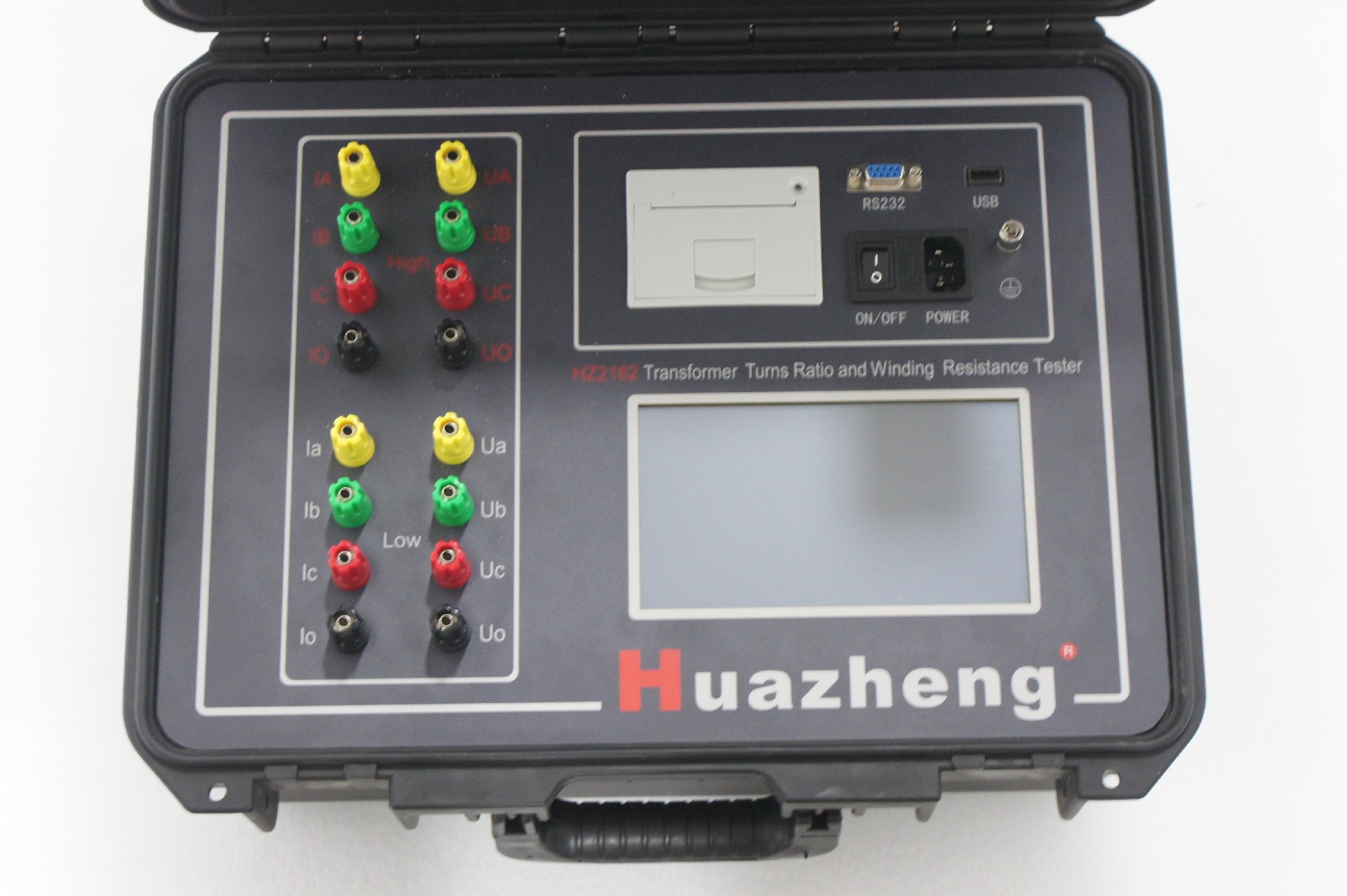
HZ-2162 DC Ratio Integrated Tester

 中文
中文
 English

 +86-312-6775656
 +86 13731210226
 sales03@bdhuazheng.com
