1. Analysis of abnormal operation of transformer
(1) The transformer sound is abnormal
As soon as the transformer is powered on, there will be a buzzing sound, which is mainly due to the high-voltage magnetic flux. During normal operation, the sound of the transformer is uniform. When there are other noises, the cause should be carefully found and dealt with.
1. The sound of the transformer is louder than usual and the sound is uniform. This may be due to the following reasons:
(1) Overvoltage occurs in the power grid. When a single-phase grounding occurs in the power grid or a resonant overvoltage occurs, the sound of the transformer will increase. When this happens, a comprehensive judgment can be made based on the instructions of the voltmeter.
(2) When the transformer is overloaded, it will make a heavy "buzzing" sound. If the load of the transformer is found to exceed the allowable normal overload value, the load of the transformer should be reduced according to the on-site regulations.
Solution: Analyze the cause, keep records, strengthen monitoring, and restore the transformer to normal operation as soon as possible. If it is caused by overload, follow the overload handling principle.
2. The transformer has noise
It is possible that the vibration is caused by some loose parts on the transformer. If there is a significant increase in the sound of the transformer and there are no obvious abnormalities in the current and voltage, it may be caused by loosening of the internal clamps or the screws holding down the iron core, which increases the vibration of the silicon steel sheet.
Treatment method: If it does not affect the operation of the transformer, no treatment can be carried out temporarily. Keep records, strengthen monitoring, report to dispatch and relevant leaders to apply for power outage inspection and processing.
3. There is discharge sound from the transformer
The transformer has a "crackling" discharge sound. If you see blue corona or sparks near the transformer bushing at night or in rainy weather, it means that the porcelain parts are seriously dirty or the equipment line card has poor contact. If the internal discharge of the transformer is caused by electrostatic discharge from ungrounded components or discharge between coil turns, or discharge due to poor contact of the tap changer.
Solution: At this time, the dispatcher and relevant leaders should be reported to apply for power outage inspection of the transformer.
4. There is a bursting sound from the transformer
It means that the insulation inside or on the surface of the transformer is broken down, and the transformer should be stopped immediately for inspection.
5. There is a sound of water boiling in the transformer
If there is a sound of water boiling in the transformer, the temperature changes sharply, and the oil level rises, it should be judged as a short circuit in the transformer winding or severe overheating caused by poor contact of the tap changer, and the transformer should be immediately deactivated for inspection.
(2) The upper oil temperature is high
Usually, the temperature of the upper oil of the transformer must be detected during operation, and the temperature of the windings can be controlled by supervising the temperature of the upper oil to prevent the insulation level from declining and aging. Under normal load and normal cooling conditions, if the transformer oil temperature is more than 10°C higher than usual or if the transformer load remains unchanged and the oil temperature continues to rise, if the inspection results prove that the cooling device is in good condition and the thermometer has no problem, it is considered that an internal problem has occurred in the transformer. Failure (such as iron core fire and short circuit between winding turns, etc.). At this time, the transformer should be stopped immediately to prevent the transformer accident from expanding.
(3) Abnormal oil color
Normally, transformer oil should be bright yellow and transparent. When the color of the oil in the oil level gauge changes during operation, you should contact us to take an oil sample for laboratory analysis. If the oil color of the transformer suddenly deteriorates during operation, carbon appears in the oil and other abnormal phenomena occur, the power should be cut off immediately for inspection and treatment.
(4) The oil level is abnormal
The oil conservator of the transformer is equipped with an oil level gauge, which generally shows three oil level lines when the temperature is -30°C, +20°C, and +40°C. According to these three marking lines, you can judge whether you need to refuel or drain the oil.
High oil level:
When the oil level of a running transformer is too high or oil overflows from the oil conservator, you should first check whether the load and temperature of the transformer are normal. If the load and temperature are normal, it can be determined that the cause is caused by the blockage of the respirator or oil standard pipe. false oil level. At this time, with the consent of the on-duty dispatcher, the gas (heavy gas) protection should be changed to the signal, and then the respirator should be unblocked for processing. If the ambient temperature is too high and the oil pillow overflows, the oil should be drained.
Low oil level:
If the oil level of the transformer is too low, the gas (light gas) protection will activate; when there is severe oil shortage, the iron core and windings are exposed to the air and are susceptible to moisture, which may cause insulation breakdown. Therefore, the vacuum oil filling method should be used to clean the operating transformer. Carry on refueling. If the oil level drops rapidly due to a large amount of oil leakage, drops below the gas relay or continues to drop, the transformer should be stopped immediately.
(5) Overload
When a running transformer is overloaded, the ammeter indication may exceed the stable value, and signals and alarm bells may operate. Operators should handle it according to the following principles:
① Check whether the current on each side exceeds the specified value and report it to the person on duty.
② Check whether the oil level and oil temperature of the transformer are normal, and put all coolers into operation.
③Adjust the operating mode in time. If there is a spare transformer, it should be put into operation.
④Contact dispatch to adjust load distribution in a timely manner.
⑤ If it is a normal overload, the allowable operating time can be determined based on the multiple of the overload, and the oil level and oil temperature should be monitored more closely. The allowable values must not be exceeded. If the time is exceeded, the load should be reduced immediately.
⑥ If it is an accidental overload, the allowable multiple and time of the overload should be implemented in accordance with the regulations of the manufacturer. If the overload multiple and time exceed the allowable value, the transformer's compliance should also be reduced according to regulations.
⑦ Conduct a comprehensive inspection of the transformer and its related systems. If any abnormalities are found, they should be reported and dealt with.
(6) Cooling system failure
When the transformer cooling system (referring to the submersible oil pump and cooling water system) fails and the transformer sends out the cooler backup input and cooler full stop signals, the following handling should be done:
1. Check immediately whether the backup cooler has been put into operation.
2. Immediately check the cause of the power outage and restore the normal operation of the cooling device as soon as possible.
3. Strengthen the monitoring of the oil temperature and oil level in the upper layer of the transformer, especially during the full shutdown time of the cooling device.
4. If the cooling system cannot be restored for a while, you should apply to reduce the load or apply for the transformer to withdraw from operation to prevent the transformer from operating beyond the specified non-cooling time, causing overheating and damage.
(7) Gas protection action
The reasons for gas protection action may be:
1. There is a slight fault in the transformer, which produces weak gas;
2. Air has invaded the transformer;
3. Oil level decreases;
4. Secondary circuit fault (such as two points of DC system grounding, etc.), causing malfunction.
After the gas protection signal appears, the operator should immediately conduct an external inspection of the transformer. First, check the oil level and color in the oil pillow, whether there is gas in the gas relay, the amount and color of the gas, etc., and then check whether there is oil leakage in the transformer body and the forced oil circulation system. At the same time, check the changes in load, temperature and sound of the transformer. If no abnormality is found after external inspection, the gas from the transformer should be sucked out to find out the nature of the gas. If necessary, the oil sample should be taken for testing to jointly determine the nature of the fault.
(8) Parts and causes that are prone to heat during operation
1. Poor contact of tap changer
Poor contact increases contact resistance, increases consumption, and generates severe heat. This is particularly likely to occur after switching taps and when the transformer is overloaded.
2. Short circuit between winding turns
An interturn short circuit is a breakdown of the insulation between adjacent turns of wire. This will create a closed short circuit loop and reduce the number of winding turns for that phase. There is a short-circuit current induced by alternating magnetic flux in the short-circuit loop, which will generate high heat and may cause the transformer to burn out.
3. There is a short circuit between the iron core silicon steel sheets.
Damage to the paint insulation between silicon steel sheets due to external force damage or insulation aging will increase eddy currents, causing local overheating and even melting damage in severe cases. This is the so-called core fire.
4. Poor contact in other parts causes local overheating.
Handling opinions: Closely monitor the temperature changes of overheated parts to ensure safe operation, analyze the causes of overheating, contact dispatch, and deal with power outages.
2. Transformer accident handling
General: According to 6.1.2 of DL/T572-95 "Power Transformer Operation Regulations":
If a transformer encounters any of the following conditions, it should be shut down immediately. If there is a spare transformer in use, it should be put into operation as soon as possible:
a. The sound of the transformer increased significantly, which was very abnormal, and there was a popping sound inside;
b. Serious oil leakage or oil injection causes the oil level to drop below the indication limit of the oil level gauge;
c. The casing is seriously damaged and discharged;
d. The transformer smoked and caught fire.
(1) Automatic tripping of transformer
After the transformer automatically trips, the following inspections and treatments should be made:
① After the transformer automatically trips, the operating personnel should carry out systematic processing, that is, put in the backup transformer, adjust the operating mode and load distribution, and maintain the operating system and its equipment in normal conditions.
② Check what kind of protective action and whether the action is correct.
③ Understand whether there are any faults in the system and the nature of the faults.
④ A trial power supply without external inspection is allowed under the following circumstances: accidental contact by personnel, misuse of operation and malfunction of protection; only low-voltage overcurrent or limited time overcurrent protection operates, and at the same time, the next-level equipment of the tripping transformer fails and its protection does not operate. And the fault point has been isolated.
⑤ If it is a protective action such as differential, gas protection or quick-break overcurrent protection, and there is an impact during the fault, it is necessary to conduct a detailed inspection of the transformer and its system, cut off the power and measure the insulation. It is forbidden to put the transformer into operation before the cause is identified or dealt with.
(2) Gas protection action (trip)
When the gas protection action of the transformer trips, the following inspections and treatments should be made:
a) Collect the gas from the gas relay for chromatographic analysis. If there is no gas, check whether the secondary circuit and the terminals and leads of the gas relay are well insulated.
b) Check whether the oil level, oil temperature and oil color have changed;
c) Check whether the explosion-proof pipe is broken and spray fuel;
d) Check whether the transformer shell is deformed and whether the welds are lined with oil.
e) If no abnormality is found after inspection, and it is confirmed that the malfunction is caused by the secondary circuit fault, the gas protection can be connected to the signal or withdrawn when the differential protection and over-current protection are turned on, and the power can be tried once and strengthened. Monitor.
f) If there is gas in the gas relay or there is a problem with the above items a, b, c, d, a power outage inspection and corresponding treatment should be carried out, and the inspection and test should be passed before it is put into operation.
(3) Transformer overcurrent protection action
When the transformer overcurrent protection trips, the following inspections and treatments should be made:
a) Check whether there are short circuits and debris on the busbar and the equipment on the busbar;
b) Check whether several measuring devices of the transformer are short-circuited;
c) Check whether the low-voltage side protection operates and whether the protection of each line operates.
d) When it is confirmed that the busbar has no power, the lines carried by the busbar should be opened.
e) If there is a bus failure, switching of the bus or load transfer should be considered.
f) If it is confirmed that it is an over-level trip, you should contact the dispatcher on duty and try to send power once.
g) When the test power supply is good, check out the faulty lines one by one.
h) If it is caused by a circuit, the power should be transmitted only after the fault factors are eliminated.
(4) Transformer differential protection action
After the transformer differential protection trips, the following inspections and treatments should be made:
a) Check whether there are any abnormalities in the transformer, check whether the insulators within the differential protection range are flashover or damaged, and whether the leads are short-circuited.
b) If there is no obvious fault in the equipment within the differential protection range, check whether the relay protection and secondary circuit are faulty, and whether the DC circuit is grounded at two points.
c) After the above inspection shows no faults, and after reporting to the chief engineer for approval, a step-up pressure test should be carried out when the load is disconnected. If it is found to be good, it should be put into operation.
d) If the malfunction is caused by relays, secondary circuits, etc., the differential protection can be exited and the transformer put into operation with the consent of the chief engineer.
e) When differential protection and gas protection operate simultaneously to cause the transformer to trip, the transformer shall not be put into operation without internal inspection and testing.
(5) Transformer on fire
Principles for handling transformer fire: power outage - drain oil - extinguish fire.
① Power outage: If the transformer catches fire and the protection does not trip automatically, you should first disconnect all circuit breakers and isolating switches connected to it, and exit the cooler to disconnect its power supply. If the operation of adjacent equipment is endangered, you should also contact us in time to stop the operation of adjacent equipment.
② Oil drain: If the oil overflows and catches fire on the top cover of the transformer, the oil drain valve at the bottom of the transformer should be opened and the oil should be drained to the accident oil pool so that the oil level of the transformer is lower than the fire level; if the fire is caused by an internal fault of the transformer, it cannot be drained. oil to prevent explosion; if the transformer shell is ruptured and oil overflows, the electric drain valve of the transformer oil pool should be closed, the electric oil drain valve should be opened, and the oil should be drained to the main transformer accident oil pool.
③ Start the fire water pump and open the fire water valve to spray the transformer to extinguish the fire. ④ Report to superiors and activate emergency plan. ⑤Notify the fire department to assist in handling the problem.
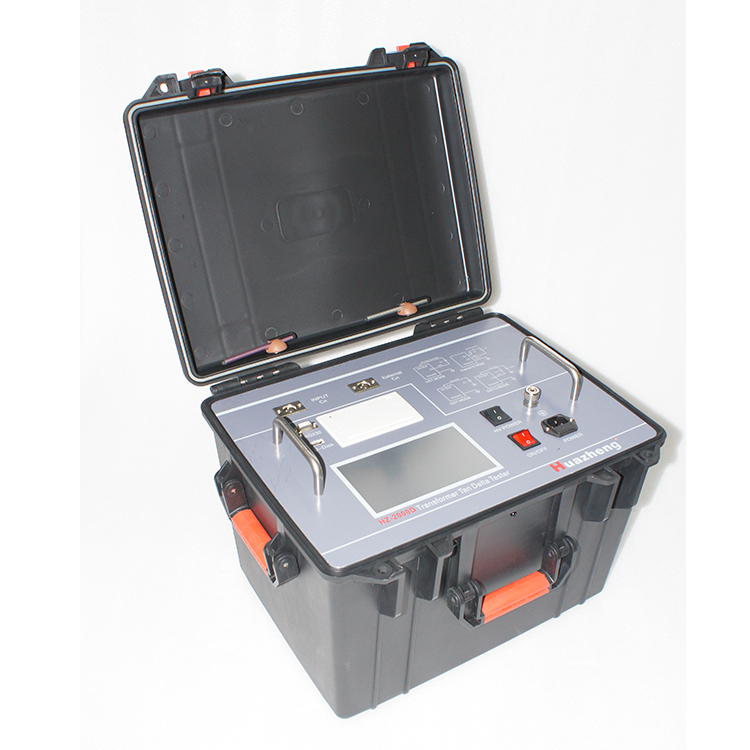
HZ-2000D Transformer Tan Delta Tester

 中文
中文
 English

 +86-312-6775656
 +86 13731210226
 sales03@bdhuazheng.com
