We all know that PLC is the core device in the field of industrial control, and it is widely used in the field of control. The industrial control devices I use in my daily work include frequency converters, touch screens and PLCs. PLC is the industrial control product I have the most contact with. In the field of use, I think there are three ways for PLC to sense external signals. One is through switches. One way of measuring quantity is through industrial Ethernet communication, and the other is to obtain information outside the PLC through analog quantity that we are going to talk about today. Today I will mainly talk about how PLC obtains external analog signals.
Methods for PLC to obtain analog quantities. If PLC wants to obtain external information, it generally needs to obtain it through the input port. Most of the signals that can be recognized by the general PLC input port are switching signals or digital signals. For continuously changing analog quantities, the PLC needs to obtain them through the input port. A special module is used to read these analog signals. We call this module the A/D conversion module. For example, in PLC control projects, when analog signal inputs such as temperature and humidity are often exposed, it is necessary to Analog signals are converted into digital signals so that signal processing can be performed.
Understanding of relays
A relay is an electronic control device with a control system (also called an input loop) and a controlled system (also called an output loop). It is usually used in automatic control circuits. It is actually an "automatic switch" that uses a smaller current to control a larger current. It plays the role of automatic adjustment, safety protection, and rotation in the circuit...
When the PLC obtains analog quantities, it not only needs to go through the A/D conversion module, but also the input signal of this analog quantity must match the output signal of the sensor we use. There are generally three types of analog input signals for PLC A/D conversion modules. The first is a 0-5V voltage signal; the second is a 0-10V voltage signal; and the third is a 4-20mA current signal. . Therefore, we need to identify it from the fact that the sensor can output one of these three signals. For example, if we want to use PLC to control temperature and humidity, we can use temperature sensors and humidity sensors with standard signals of 0-10V output.
After the A/D module of the PLC obtains the analog signal, it needs to convert it into digital data, and then further performs dimensional conversion so that the unit values of temperature and humidity can be obtained. This can generally use the arithmetic inside the PLC. Arithmetic instructions are implemented. In actual control, sometimes we have to consider the control accuracy. For ordinary control projects, we can choose 12-bit conversion accuracy, because the higher the conversion accuracy, the higher the production cost.
Let's take PLC temperature control as an example. After the hardware is completed, software needs to be written. The process of software execution is actually a process of reading analog quantities. The first step for the PLC to read the analog quantity is to write a program for the temperature detection conversion function. Then, you need to write a program that can realize the temperature dimension conversion function. Then you need to write a program that compares the temperature data and can output control. By writing the above four-step program, we have realized a process of PLC reading analog values.
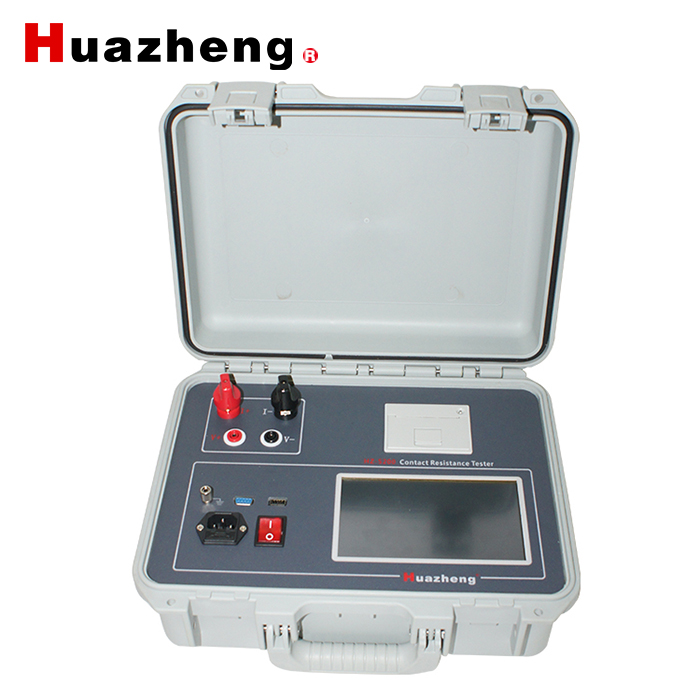
HZ-5200 Contact ResistanceTester

 中文
中文
 English

 +86-312-6775656
 +86 13731210226
 sales03@bdhuazheng.com
