1. Harm of unbalanced three-phase load of distribution transformer
1. Increased line loss: The load loss of the distribution transformer changes with the load current of the transformer, and is proportional to the square of the load current. When the transformer delivers the same capacity, the three-phase load is unbalanced, and its active loss increases. .
In addition, power loss will also occur on the wire. The greater the imbalance, the greater the line loss.
2. Increase the power loss of the distribution transformer: The distribution transformer is the main power supply equipment of the low-voltage power grid. When it operates under the condition of unbalanced three-phase load, it will increase the loss of the distribution transformer. Because the power loss of the distribution transformer changes with the unbalanced load.
3. The output of the distribution transformer is reduced: when the distribution transformer is designed, its winding structure is designed according to the load balance operating condition, and its winding performance is basically the same, and the rated capacity of each phase is equal.
The maximum allowable output of the distribution transformer is limited by the rated capacity of each phase. If the distribution transformer operates under unbalanced three-phase load conditions, the light-loaded phase will have surplus capacity, thereby reducing the output of the distribution transformer.
The reduction degree of its output is related to the unbalance degree of the three-phase load. The greater the unbalanced three-phase load, the greater the output reduction of the distribution transformer. For this reason, when the distribution transformer operates when the three-phase load is unbalanced, its output capacity cannot reach the rated value, its reserve capacity is correspondingly reduced, and its overload capacity is also reduced.
If the distribution transformer operates under overload conditions, it is very easy to cause the distribution transformer to heat up, and even cause the distribution transformer to burn out in severe cases.
4. The distribution transformer generates zero-sequence current: the distribution transformer operates under the condition of unbalanced three-phase load, and will generate zero-sequence current, which will vary with the degree of unbalanced three-phase load. The sequence current is also larger.
When the zero-sequence current passes through the steel components, hysteresis and eddy current loss will be generated, which will cause the local temperature of the steel components of the distribution transformer to rise and generate heat, and the winding insulation will age due to overheating, resulting in a reduction in equipment life.
5. Affect the safe operation of electrical equipment: the distribution transformer is designed according to the three-phase load balance operating condition, and the resistance, leakage reactance and excitation impedance of each phase winding are basically the same.
When the distribution transformer operates under the three-phase load balance, its three-phase current is basically equal, and the voltage drop of each phase inside the distribution transformer is also basically the same, so the three-phase voltage output by the distribution transformer is also balanced.
If the distribution transformer operates when the three-phase load is unbalanced, the output current of each phase will be unequal, and the three-phase voltage drop inside the distribution transformer will be unequal, which will inevitably lead to the three-phase unbalance of the output voltage of the distribution transformer.
At the same time, the distribution transformer operates when the three-phase load is unbalanced, the three-phase output current is different, and the neutral line will have current passing through it. As a result, the neutral line produces an impedance voltage drop, which causes the neutral point to drift, resulting in a change in the phase voltage of each phase, which seriously endangers the safe operation of the electrical equipment.
6. The efficiency of the motor is reduced: the operation of the distribution transformer under the condition of unbalanced three-phase load will cause the three-phase unbalance of the output voltage. When this unbalanced voltage is input to the motor, the rotating magnetic field generated by the negative sequence voltage is opposite to the rotating magnetic field generated by the positive sequence voltage, which acts as a brake.
However, since the positive sequence magnetic field is much stronger than the negative sequence magnetic field, the motor still rotates in the direction of the positive sequence magnetic field. However, due to the braking effect of the negative sequence magnetic field, the output power of the motor will be reduced, resulting in a reduction in the efficiency of the motor.
At the same time, the temperature rise and reactive power loss of the motor will also increase with the unbalance of the three-phase voltage. Therefore, it is very uneconomical and unsafe for the motor to run under the condition of unbalanced three-phase voltage.
2. Causes of unbalanced three-phase load
(1) Insufficient understanding of the importance of three-phase load balance. The management personnel did not strictly follow the rules and regulations in management, and did not follow the assessment requirements.
(2) A large number of single-phase electrical equipment exists. In recent years, a large number of high-end, high-power single-phase electrical appliances have entered the homes of ordinary people. In the case of a huge increase in single-phase load power consumption, coupled with the inconsistent probability of simultaneous use, the three-phase load imbalance of the low-voltage power grid may increase.
(3) Because the management personnel are not familiar with the three-phase load change law and distribution situation in the station area, when applying for power consumption for new single-phase users, especially large single-phase equipment cannot be distributed according to the three-phase load balance distribute.
(4) Temporary electricity consumption and seasonal electricity consumption increase, such as during summer, winter, and holidays, the increase in electricity consumption of each user is inconsistent, resulting in unbalanced three-phase loads.
3. Improvement measures
1. Solutions to the unbalanced three-phase voltage of the power grid caused by asymmetrical loads:
(1) Distribute asymmetrical loads to different power supply points to reduce the problem of serious imbalance caused by centralized connections.
(2) Use the method of cross-exchanging to make the asymmetric load reasonably distributed to each phase, and make it as balanced as possible.
(3) Increase the short-circuit capacity of the load access point, such as changing the network or increasing the power supply voltage level to improve the system's ability to withstand unbalanced loads.
2. Strengthen management
(1) Every year, special personnel are organized to draw transformer network diagrams and load distribution diagrams, and formulate relevant data such as the number of power users on each phase and the model of electric energy meters into a convenient and easy-to-check form, and check whether there are any omissions or new users. Combined with load changes, it is updated in time.
(2) Equip special personnel with a clamp meter, and conduct a load test at least once a month to check the three-phase load imbalance.
(3) For temporary and seasonal electricity consumption, management personnel are required to be familiar with the basic situation of users, installation location, changes in power consumption, etc., and then make timely adjustments according to the situation.
(4) Newly added single-phase equipment applies for power consumption, and the power distribution of the load is done well, and it is distributed to the three-phase circuit as evenly as possible.
3. Adjust the three-phase unbalanced load to achieve "four balance"
"Four balances" include metering point balance, each branch balance, main line balance and transformer low-voltage outlet side balance.
Among the four balances, the focus is on the balance of metering points and each branch. The average power consumption of users can be used as the basis for adjustment, and those with roughly the same power consumption can be regarded as a category and evenly adjusted to the three phases.
4. Bring the three-phase line into the load point at the same time
Since the loss is significantly reduced when the three-phase is introduced into the load point at the same time as compared with the single-phase load point, in order to obtain the symmetry of the three-phase load, the three-phase line should be introduced into the load point at the same time.
Expand the power distribution area of the three-phase four-wire system as far as possible, and reduce the length of the single-phase power supply main line. The household wires should be introduced from the three phases u, v, and w on the same pole as much as possible. And the loads of the three sets of single-phase household wires should be balanced as much as possible.
5. Reasonable design of power grid transformation plan
Combined with line transformation, in order to achieve three-phase load balance after transformation, the power grid transformation plan must be reasonably designed. Before designing, it is necessary to understand the law of load changes and load distribution, conduct on-site surveys, master the load distribution, and draw load distribution wiring diagrams.
Carry out wiring in strict accordance with the principle of three-phase load balance, and try to make three-phase four-wire go deep into each important load center.
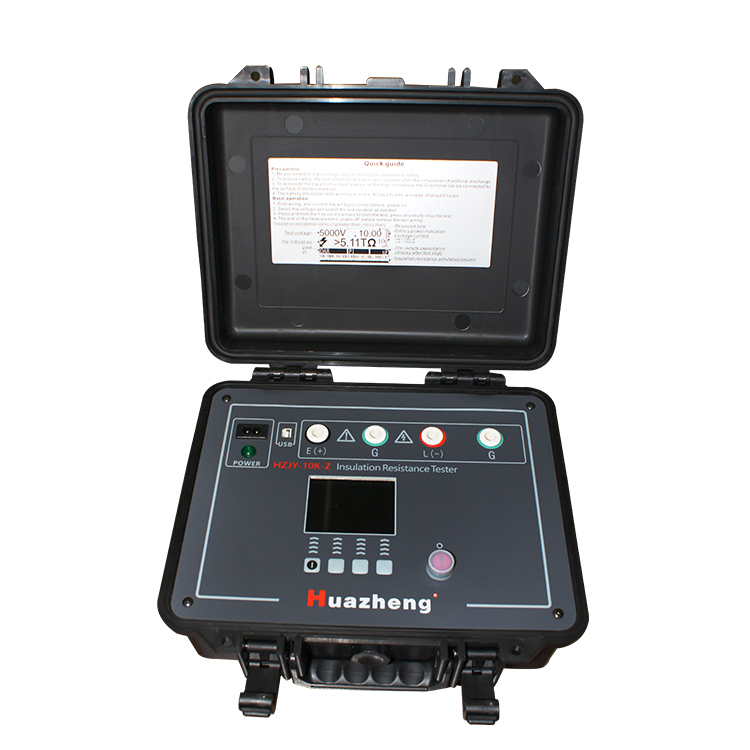
HZJY-10K-Z Insulation Resistance Testing Unit

 中文
中文
 English

 +86-312-6775656
 +86 13731210226
 sales03@bdhuazheng.com
