Three-phase unbalance is an important indicator of power quality. Although there are many factors that affect the power system, the normal unbalance is mostly due to three-phase components, line parameters or load asymmetry. Since the factors of the three-phase load are not certain, the three-phase voltage and current of the power supply point are prone to unbalance, and the line is lost. Not only that, but it will also have an adverse effect on the motor on the power supply point, endangering the normal operation of the motor. Therefore, if the three-phase imbalance exceeds the acceptable range of the distribution network, the safe operation of the overall power system will be affected.
The basic concept of three-phase unbalance
Three-phase unbalance refers to the inconsistency of the three-phase current (or voltage) amplitude in the power system, and the amplitude difference exceeds the specified range. Due to the unbalanced load applied by the power supply of each phase, it belongs to the problem of fundamental wave load configuration. The occurrence of three-phase unbalance is related to the user load characteristics, and also related to the planning and load distribution of the power system. In the power grid system, three-phase balance mainly refers to the three-phase voltage phasors being equal in size, and if they are arranged in the order of A, B, and C, the angle formed between them is 2n/3. The three-phase unbalance refers to the inconsistency of the phasor size and angle. "Power Quality Three-phase Voltage Permissible Unbalance" (GB/T15543-1995) is applicable to AC rated frequency of 50 Hz. In the normal operation mode of the power system, the voltage unbalance at the connection point of the PCC point due to the negative sequence component. The standard stipulates that the allowable value of the unbalance degree of the common connection point of the power system is 2% under normal operation mode, and shall not exceed 4% for a short time.
Three-phase current unbalance calculation method
Unbalance % (THDi) = (maximum current - minimum current) / maximum current × 100%
Unbalance % (THDi) = (MAX phase current - three-phase average current) / three-phase average current × 100%
for example:
The three-phase currents are IA=9A IB=8A IC=4A, then the average current of the three phases is 7A, the phase current-the average current of the three phases is 2A 1A 3A respectively, and the one with the largest difference is taken, so MAX (phase current-three-phase Average current) = 3A, so the three-phase current imbalance = 3/7.
Causes of Three Phase Unbalance
There are many reasons for unbalanced three-phase voltage, such as: single-phase grounding, disconnected resonance, etc. Operation and management personnel can only deal with it quickly if they are correctly distinguished.
1. Disconnection fault
If one phase is disconnected but not grounded, or one phase of the circuit breaker and isolating switch is not connected, the fuse of the voltage transformer is blown, which will cause the asymmetry of the three-phase parameters. When one phase of the line at the previous voltage level is disconnected, the voltage of the next voltage level shows that the voltages of the three phases are all reduced, one of which is lower, and the other two are higher but the voltage values of the two are close. When the line of this level is broken, the phase voltage of the broken line is zero, and the phase voltage of the unbroken line is still the phase voltage.
2. Ground fault
When one phase of the line is broken and the single phase is grounded, although the three-phase voltage is unbalanced, the voltage value does not change after the grounding. Single-phase grounding is divided into two types: metallic grounding and non-metallic grounding. Metallic grounding, the faulty phase voltage is zero or close to zero, the non-faulty phase voltage increases by 1.732 times, and remains unchanged for a long time; non-metallic grounding, the grounding phase voltage is not zero but decreases to a certain value, and the other two phases rise Less than 1.732 times higher.
3. Causes of resonance
With the rapid development of industry, non-linear power loads have increased a lot, and some loads not only generate harmonics, but also cause fluctuations and flicker of supply voltage, and even cause unbalanced three-phase voltage.
There are two types of three-phase voltage imbalance caused by resonance:
(1) Fundamental frequency resonance
Fundamental frequency resonance, the characteristics are similar to single-phase grounding, that is, the voltage of one phase decreases, and the voltage of the other two phases increases. It is difficult to find the fault point when looking for the cause of the fault. At this time, special users can be checked. If it is not the reason for grounding, it may be caused by resonance .
(2) Frequency division resonance
The other is frequency division resonance or high frequency resonance, which is characterized by the simultaneous rise of the three-phase voltage.
In addition, it should also be noted that when part of the line is cut off by the airdrop bus or the single-phase ground fault disappears, if there is a ground signal and the voltage of one phase, two phases or three phases exceeds the line voltage, the pointer of the voltmeter will hit the head and move slowly at the same time, or The three-phase voltage rises higher than the line voltage in turn. In this case, it is generally caused by resonance.
4. Unreasonable distribution of three-phase load
Many workers who install meters and connect electricity do not have a professional knowledge concept of three-phase load balance, so they do not pay attention to the control of three-phase load balance when connecting electricity, but blindly and casually connect and install circuits. table, which to a large extent caused the unbalance of the three-phase load. Secondly, most of the circuits in our country are integrated with power and lighting, so when using single-phase electrical equipment, the efficiency of electricity consumption will be reduced. This difference further exacerbates the three-phase load of distribution transformers. balance.
5. Constant changes in electricity load
The reasons for the unstable power load include the frequent demolition, meter shifting or increase of electricity users in the district II; the instability of temporary power consumption and seasonal power consumption. Such uncertainty and non-concentration in the total amount and time make the load of electricity consumption also have to change with the actual situation.
6. The weakening of the monitoring of distribution transformer load
In the management of distribution network, the management problems in three-phase load distribution are often ignored. In the detection of the distribution network, the three-phase load of the distribution transformer has not been regularly detected and adjusted. In addition, there are many factors that cause the phenomenon of three-phase unbalance, such as the influence of the line and the in-phase of the three-phase load moment, etc.
Three-phase unbalance hazard
1. Increase the power loss of the line
In the three-phase four-wire power supply network, when the current passes through the line wire, the electric energy loss is bound to occur due to the existence of impedance, and the loss is proportional to the square of the passing current. When the low-voltage power grid is powered by a three-phase four-wire system, due to the existence of single-phase loads, it is inevitable to cause unbalanced three-phase loads. When the three-phase load is unbalanced, the neutral wire will have current flow. In this way, not only the phase line has loss, but also the neutral line has loss, which increases the loss of the grid line.
2. Increase the power loss of distribution transformers
The distribution transformer is the main power supply equipment of the low-voltage power grid. When it operates under the unbalanced three-phase load condition, it will increase the distribution transformer loss. Because the power loss of the distribution transformer changes with the unbalanced load.
3. Reduced distribution output
When the distribution transformer is designed, its winding structure is designed according to the load balance operating condition, its winding performance is basically the same, and the rated capacity of each phase is equal. The maximum allowable output of the distribution transformer is limited by the rated capacity of each phase. If the distribution transformer operates under unbalanced three-phase load conditions, the light-loaded phase will have surplus capacity, thereby reducing the output of the distribution transformer. The reduction degree of its output is related to the unbalance degree of the three-phase load. The greater the unbalanced three-phase load, the greater the output reduction of the distribution transformer. For this reason, when the distribution transformer operates when the three-phase load is unbalanced, its output capacity cannot reach the rated value, its reserve capacity is correspondingly reduced, and its overload capacity is also reduced. If the distribution transformer operates under overload conditions, it is very easy to cause the distribution transformer to heat up, and even cause the distribution transformer to burn out in severe cases.
4. The distribution transformer generates zero-sequence current
When the distribution transformer operates under the condition of unbalanced three-phase load, it will generate zero-sequence current, which will change with the degree of unbalanced three-phase load. The greater the degree of unbalance, the greater the zero-sequence current. If there is zero-sequence current in the distribution transformer in operation, zero-sequence magnetic flux will be generated in its iron core. (There is no zero-sequence current on the high-voltage side) This forces the zero-sequence magnetic flux to pass only through the fuel tank wall and steel components, and the magnetic permeability of the steel components is low. When the zero-sequence current passes through the steel components, hysteresis and eddy current will be generated Loss, so that the local temperature of the steel components of the distribution transformer heats up. The winding insulation of the distribution transformer ages faster due to overheating, resulting in a reduction in equipment life. At the same time, the storage of zero-sequence current will also increase the loss of distribution transformer.
5. Affect the safe operation of electrical equipment
The distribution transformer is designed according to the operating condition of three-phase load balance, and the resistance, leakage reactance and excitation impedance of each phase winding are basically the same. When the distribution transformer operates under the three-phase load balance, its three-phase current is basically equal, and the voltage drop of each phase inside the distribution transformer is also basically the same, so the three-phase voltage output by the distribution transformer is also balanced. If the distribution transformer operates when the three-phase load is unbalanced, the output current of each phase will be unequal, and the three-phase voltage drop inside the distribution transformer will be unequal, which will inevitably lead to the three-phase unbalance of the output voltage of the distribution transformer. At the same time, the distribution transformer operates when the three-phase load is unbalanced, the three-phase output current is different, and the neutral line will have current passing through it. As a result, the neutral line produces an impedance drop, which causes the neutral point to drift, resulting in changes in the phase voltage of each phase. The voltage of one phase with heavy load decreases, while the voltage of one phase with light load increases. When the voltage is unbalanced, it is easy to burn out the user's electrical equipment connected to the high-voltage phase, while the user's electrical equipment connected to the low-voltage phase may be unusable. Therefore, when the three-phase load is unbalanced, it will seriously endanger the safe operation of electrical equipment.
6. Reduced motor efficiency
The operation of the distribution transformer under the condition of unbalanced three-phase load will cause the three-phase unbalance of the output voltage. Since the unbalanced voltage has three voltage components: positive sequence, negative sequence, and zero sequence, when this unbalanced voltage is input to the motor, the negative sequence voltage generates a rotating magnetic field that is opposite to the rotating magnetic field generated by the positive sequence voltage, and acts as a brake. effect. However, since the positive sequence magnetic field is much stronger than the negative sequence magnetic field, the motor still rotates in the direction of the positive sequence magnetic field. However, due to the braking effect of the negative sequence magnetic field, the output power of the motor will be reduced, resulting in a reduction in the efficiency of the motor. At the same time, the temperature rise and reactive power loss of the motor will also increase with the unbalance of the three-phase voltage. Therefore, it is very uneconomical and unsafe for the motor to run under the condition of unbalanced three-phase voltage.
Treatment of three-phase imbalance
01. Pay attention to the reasonable distribution of three-phase load
On the distribution of three-phase loads, electric power workers should carefully collect and record relevant data in actual work, so as to be able to predict the power load to a certain extent. Secondly, the distribution problem of better three-phase balance can be achieved by installing a balancing device. In some places where the low-voltage three-phase four-wire system is used, an unbalanced current reactive power compensation device can be added to solve various consequences caused by the unbalanced current phenomenon in the power grid that often occurs. Such a device can not only compensate system reactive power, but also adjust the effect of unbalanced active current. In addition, according to the different conditions of the load moment in the actual situation, the appropriate adjustment of the wiring method will also have a certain impact on the rational distribution of the three-phase load.
02. Treatment method for unbalanced current in three-phase load
According to the compensation principle of unbalanced current susceptance, at any moment that can be determined, there are mainly three-phase ungrounded unbalanced loads, then each of their phase loads can be connected in parallel with a resistor and capacitor. Therefore, under the guidance of the theory of susceptance compensation for unbalanced current control, the equivalent of different properties can be analyzed to determine the amount of reactive power compensation between phases and phases. When the distribution transformer needs to compensate the unbalanced current, the following principles should be met. First, it should be noted that current management should have two contents, one is to compensate the power factor, and the other is to adjust the three-phase current imbalance. The two together determine the reactive power required for compensation. The second point is that in actual engineering construction, a full-capacitance treatment method should be adopted to distinguish it from inductance compensation to avoid serious overcompensation. The third point is that it needs to be considered that the load will change with time. Based on this characteristic, the compensation amount should also be adjusted appropriately according to the change of the load. The fourth point is reflected in the limitation of switching times of device switching and compensation equipment, and the optimization plan for the whole day should be strategically managed during design. In short, when setting the amount of the proportional adjustment coefficient, it is necessary to consider the limiting conditions of the power factor and the limiting conditions of the over-compensation at the same time.
03. Added detection and adjustment of three-phase load
It is also very necessary to regularly set up detection work on three-phase loads. After the reasonable allocation and control of the three-phase coincidence, the relevant departments should start the testing work. The balance of electricity cannot be absolute, it can only be done to achieve a relative balance. In the actual testing work, each department should take the measurement index of the balance degree formulated by the state and relevant departments as a standard, and carry out professional testing on the results of the test. The record and analysis of the load current of each phase are regularly detected, so as to find some unbalanced conditions of the three phases in time. When a potential safety hazard is found during the inspection process, adjustments and modifications must be made in a timely manner. You should also be vigilant about the parts where no problems are found during the inspection. After the test is completed, not only data collation and analysis are required, but also timely feedback is required. The feedback here mainly refers to the adjustments that need to be made for the three phases inferred from the test results, and the possibility prediction of the application of new technologies in the three phases. Through reasonable detection and in-depth analysis of the detection results, we can avoid the occurrence of imbalance to the greatest extent and reduce the occurrence of electricity accidents.
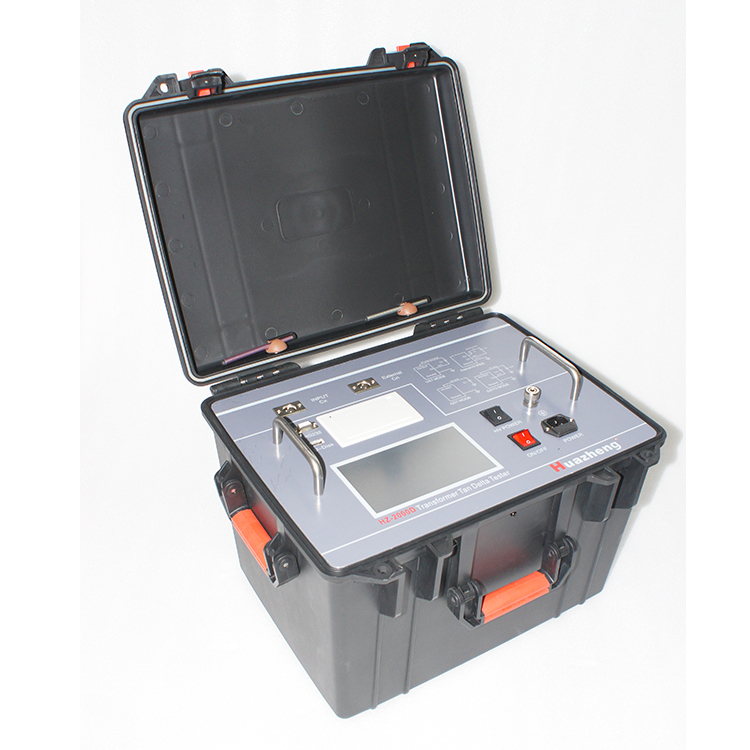
HZ-2000D Transformer Tan Delta Tester

 中文
中文
 English

 +86-312-6775656
 +86 13731210226
 sales03@bdhuazheng.com
