1. Basic principles
The relay protection device must have the function of correctly distinguishing whether the protected element is in normal operation or has a fault, whether it is a fault in the protection zone or a fault outside the zone. To realize this function, the protective device needs to be constructed based on the characteristics of the electrical physical quantity changes before and after the power system fails.
After the power system fails, the main characteristics of the power frequency electrical quantity change are:
1) The current increases
When the short circuit occurs, the electrical equipment between the fault point and the power supply and the current on the transmission line will increase from the load current to greatly exceed the load current.
2) Voltage drop
When phase-to-phase short-circuit and ground-to-ground short-circuit faults occur, the phase-to-phase voltage or phase voltage value at each point of the system drops, and the closer to the short-circuit point, the lower the voltage.
3) The phase angle between current and voltage changes
During normal operation, the phase angle between current and voltage is the power factor angle of the load, which is generally about 20°. During a three-phase short circuit, the phase angle between current and voltage is determined by the impedance angle of the line, generally 60°~ 85°, and when protecting the three-phase short circuit in the opposite direction, the phase angle between the current and the voltage is 180°+(60°~85°).
4) Changes in measured impedance
The measured impedance is the ratio of the measured point (protected installation) voltage to current. During normal operation, the measured impedance is the load impedance; when the metal is short-circuited, the measured impedance is transformed into line impedance, and the measured impedance decreases significantly after the fault, while the impedance angle increases.
When asymmetrical short circuit occurs, phase sequence components appear, such as two-phase and single-phase ground short circuit, negative sequence current and negative sequence voltage components appear; single-phase grounding, negative sequence and zero sequence current and voltage components appear. These components are absent during normal operation. The relay protection of various principles can be formed by using the change of electrical quantity during short-circuit fault.
In addition, in addition to the above-mentioned protections that respond to power frequency electrical quantities, there are also protections that respond to non-power frequency electrical quantities, such as gas protection.
2. Basic requirements
In order to complete its task, the relay protection device must technically meet the four basic requirements of selectivity, quick action, sensitivity and reliability. For relay protection acting on relay tripping, four basic requirements should be met at the same time, and for relay protection devices acting on signals and only reflecting abnormal operating conditions, some of these four basic requirements can be reduced.
1. Selectivity
Selectivity means that when a short circuit occurs in a device or line in the power system, its relay protection only cuts off the faulty device or line from the power system. The protection of adjacent equipment or lines will remove the fault.
2. Quickness
Quick action means that the relay protection device should be able to cut off the fault as soon as possible, so as to reduce the time for equipment and users to operate in high current and low voltage, reduce the damage of equipment, and improve the stability of parallel operation of the system.
Generally, the faults that must be quickly removed are:
1) Make the bus voltage of power plants or important users lower than the effective value (generally 0.7 times the rated voltage).
2) Internal faults of large-capacity generators, transformers and motors.
3) The cross-section of medium and low-voltage line wires is too small, and it is not allowed to delay the fault in order to avoid overheating.
4) Faults that may endanger personal safety and cause strong interference to the communication system.
The fault clearing time includes the action time of protection devices and circuit breakers. Generally, the action time of fast protection is 0.04s~0.08s, and the fastest can reach 0.01s~0.04s. The tripping time of general circuit breakers is 0.06s~0.15s. The fastest can reach 0.02s ~ 0.06s.
For the relay protection device that responds to abnormal operation conditions, it is generally not required to act quickly, but to send a signal with a delay according to selective conditions.
3. Sensitivity
Sensitivity refers to the response capability of the protection device when short-circuit faults or abnormal operation occur in the protected range of electrical equipment or lines. The sensitivity of the protection device is measured by the sensitivity coefficient.
The relay protection that can meet the sensitivity requirements can react correctly regardless of the location and type of the short-circuit point and whether there is a transition resistance at the short-circuit point when a fault occurs within the specified range. It can act reliably when the three-phase short circuit occurs in the mode, and it can also act reliably when the two-phase or single-phase short-circuit fault passes through a relatively large transition resistance in the minimum operation mode of the system.
The maximum operating mode of the system:
When the end of the protected line is short-circuited, the equivalent impedance of the system is the minimum, and the short-circuit current through the protection device is the maximum operation mode.
The minimum operating mode of the system:
Under the same short-circuit fault condition, the equivalent impedance of the system is the maximum, and the short-circuit current through the protection device is the minimum operation mode.
4. Reliability
Reliability includes safety and reliability, which is the most fundamental requirement for relay protection.
1) Security
It is required that the relay protection does not act reliably when it is not required to act, that is, no false action occurs.
2) Reliability
It is required that the relay protection should act reliably when a fault that should act occurs within the specified protection range, that is, it will not refuse to operate.
Misoperation and refusal of relay protection will bring serious harm to the power system. Even for the same power components, with the development of the power grid, the impact of protection against misoperation and non-rejection on the system will also change.
The above four basic requirements are the basis for design, configuration and maintenance of relay protection, and also the basis for analysis and evaluation of relay protection. These four basic requirements are interrelated, but often contradictory. Therefore, in actual work, dialectical unification should be carried out according to the structure of the power grid and the nature of users.
3. Basic tasks
The basic tasks of power system relay protection are:
1. Automatically, quickly and selectively cut off the faulty components from the power system, so as to prevent the faulty components from being further damaged, and ensure that other non-faulty parts can quickly resume normal operation.
2. Respond to the abnormal operation status of electrical components, and act on the signal according to the conditions of operation and maintenance (such as whether there are regular on-duty personnel), so that the on-duty personnel can deal with it in time, or the device will automatically adjust, or those who continue to run will be Electrical equipment causing damage or developing into an accident is removed. At this time, it is generally not required to protect the rapid action, but to set a certain delay according to the degree of harm to the power system and its components, so as to avoid unnecessary actions and interference caused by short-term operation fluctuations.
3. The relay protection device can also cooperate with other automation devices in the power system, and when conditions permit, take predetermined measures to shorten the power outage time of the accident and restore power supply as soon as possible, thereby improving the reliability of the power system operation.
4. Types of relay protection
Relay protection can be classified in the following four ways:
1. Classification according to protected objects
There are transmission line protection and main equipment protection (such as generators, transformers, busbars, reactors, capacitors, etc.).
2. Classified by protection function
There are short-circuit fault protection and abnormal operation protection. The former can be divided into main protection, backup protection and auxiliary protection; the latter can be divided into overload protection, loss of excitation protection, out-of-step protection, low frequency protection, non-full-phase operation protection, etc.
3. Classification of semaphores for comparison and operation processing by protection devices
There are analog protection and digital protection, all electromechanical, rectifying, transistor and integrated circuit (operational amplifier) protection devices, which directly reflect the continuous analog value of the input signal, are all analog protection; using microprocessor and Microcomputer protection devices, they respond to discrete digital quantities after sampling and analog/digital conversion of analog quantities, which is digital protection.
4. Classification according to the protection action principle
There are overcurrent protection, low voltage protection, overvoltage protection, power direction protection, distance protection, differential protection, longitudinal protection, gas protection, etc.
5. Abnormal
When it is found that there are abnormalities or defects in the operation of relay protection, in addition to strengthening monitoring, remove the outlet pressure plate of the protection that can cause malfunction, and then contact the relay protection personnel to deal with it.
In case of any of the following abnormal situations, you should exit in time:
1. Bus difference protection
When the "bus differential AC disconnection" and "bus differential DC voltage disappear" signals are issued; when the unbalanced current of the bus differential is not zero; the bus tie switch without a dedicated bypass bus is operating in series and switching operations.
2. High frequency protection
When the DC power supply disappears; when the parameters of the regular channel test do not meet the requirements; when the device fails or the channel abnormal signal is sent out and cannot be reset; during the operation of the side parent line switch.
3. Distance protection
When the PT is out of operation or the three-phase voltage circuit is disconnected; under normal circumstances, the magnetic current is too large or too small; when the load current exceeds the corresponding period of the protection allowable current.
4. Microcomputer protection
When the general alarm light is on and one of the four protections (high frequency, distance, zero sequence, and comprehensive weight) is on at the same time, the corresponding protection will be exited; if two CPUs fail, all protections of the device should be exited; all signal lights of the alarm plug-in are off, If the power indicator light is off, it means that the DC disappears, you should exit the outlet pressure plate, and then put it back in after the DC power supply is restored; the general alarm light and the call light are on, and the print shows CPU×ERR signal, if the CPU is normal, it means that the communication circuit between the protection and the interface CPU Abnormal, exit the CPU inspection switch processing, if the signal cannot be reset, indicating that the CPU has a fatal defect, you should exit the protection outlet pressure plate and disconnect the inspection switch processing.
5. Gas protection
When refueling, filtering oil or changing silica gel during transformer operation; when submersible oil pump or oil cooler (radiator) is put into operation after draining oil for maintenance; when it is necessary to open the vent valve or oil drain plug of the breathing system, or clean the moisture absorber; on load When someone is working on the oil circuit of the pressure regulating switch.
6. Common fault analysis of relay protection
1. Current mutual inductance saturation fault
The saturation of the current transformer has a great influence on the relay protection of the power system. With the continuous increase of the terminal load of the power distribution system equipment, if a short circuit occurs, the short circuit current will be very large. If the system is short-circuited near the terminal equipment area, the current may reach or approach more than 100 times the single rated current of the current transformer. In the case of normal short-circuit, the larger the current transformer error is, the larger the primary short-circuit current multiple is, and when the current quick-break protection reduces the sensitivity, it may prevent the action. When the line is short-circuited, due to the current saturation of the current transformer, the secondary current induced again is small or close to zero, which will also cause the definite time overcurrent protection device to fail to operate. When the overcurrent protection of the outlet line of the power distribution system refuses to operate, the protection of the inlet line of the power distribution station is activated, and the entire power distribution system will be cut off.
2. Improper selection of switch protection equipment
The selection of switch protection equipment is a very important task. Most of the current power distribution has established switch stations in areas with high load density, that is, the power supply and transmission mode of substation-switch station-distribution transformer. In the switch station that has not realized the automation of relay protection, we should use more load switches or relay equipment systems combined with them as switch protection equipment.
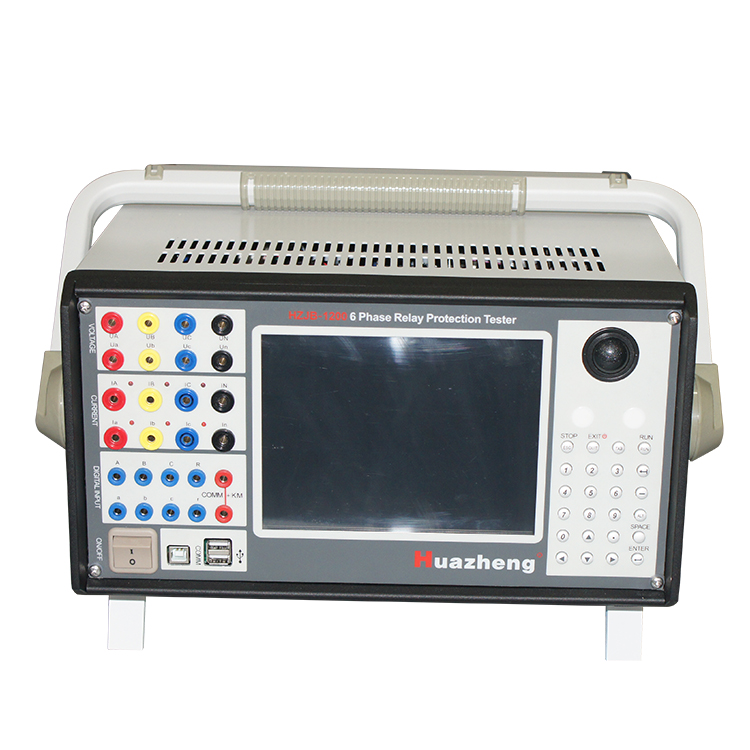
HZJB-1200 6 Phase Relay Protection Tester

 中文
中文
 English

 +86-312-6775656
 +86 13731210226
 sales03@bdhuazheng.com
