Shock test is not a technical term for power management system. It is generally a test and analysis method to determine the safety, reliability and effectiveness of military and civil construction equipment when they are subjected to external force impact or action. The impact test in electrical control engineering generally mainly includes operation impact test, lightning strike impact test, and steep wave front impact test, the purpose of which is to test the insulation strength of electrical automation equipment.
There are three types of impulse tests for power systems
1. Pulse test method, using sine wave test. For example, the sine wave vibration testing machine is widely used in national defense, aerospace, aviation, communication and other industries to adapt to early fault detection, simulated actual working condition evaluation and structural strength test.
2. Shock spectrum test method. Such as the impact test bench, it can control the magnitude and duration of the simulated impact force, and is used to accurately test the adaptability of the product to the environment. It is also used to test whether the packaging of the product can protect the product from damage during transportation and handling. .
3. Provisions on the test method of the testing machine. For example, the gravel impact testing machine is specially designed for gravel impact testing of automotive materials and surface coatings.
According to the temperature, the impact test is divided into: normal temperature impact test, which is generally within the range of 23 ± 5°C at normal temperature; low temperature impact test; after being stored in a low temperature medium for a certain period of time, the impact test can be completed quickly after the temperature reaches the requirement.
In the power grid management system, for transformers newly put into market operation, in addition to doing some necessary tests and protection and secondary factor tests according to the design standards of the handover test, before the official start of operation, they usually have to do no-load full-voltage switching. There are two purposes for the impact test on the transformer.
First, in the case of no charging, when the no-load transformer is open circuit, an operating overvoltage may occur. When the neutral point of the power system is not grounded or grounded through the arc suppression coil, the overvoltage amplitude can reach 4 to 4.5 times the phase voltage; when the neutral point is directly grounded, it can reach three times the phase voltage. Therefore, in order to test whether the insulation strength of the transformer can withstand the full voltage or operating overvoltage, an impact test is required.
Secondly, when the transformer is loaded with electricity, an exciting inrush current will be generated, and its value can be as high as 6 to 8 times the rated current. Since the exciting inrush current generates a large power, in order to check the mechanical strength of the transformer, it is necessary to conduct an impact at the same time Test to check whether the inrush current will cause the relay protection device to malfunction at the initial stage of the inrush current decay.
Usually, a newly installed transformer generally requires five times of no-load closing to fully test the insulation, mechanical strength and differential protection of the transformer. Because the closing angle at each closing moment is different, the corresponding inrush current is also different, sometimes large and sometimes small. It should continue to run for more than 10 minutes after the first impact, and wait for more than 5 minutes for the next impact. A full impact test usually takes 1 hour.
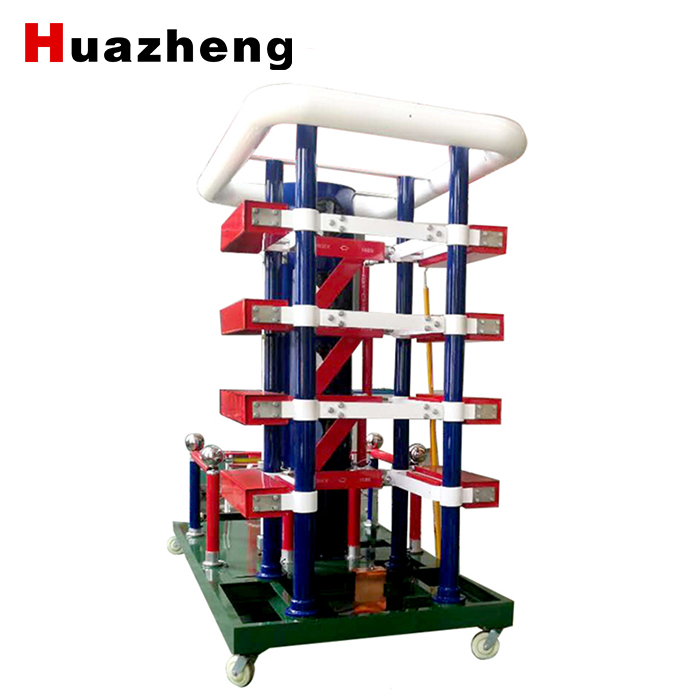
HZCJ-400 Lighting Impulse Tester

 中文
中文
 English

 +86-312-6775656
 +86 13731210226
 sales03@bdhuazheng.com
