Kinematic viscosity is an index to measure the internal friction of a liquid flowing under the action of gravity. It is the ratio of the dynamic viscosity of a liquid to its density at the same temperature, expressed in SI units by 2/second. Typically centistokes (cSt) is used as a unit. 1 centistoke = 10-6 m2/sec = 1 mm2/sec.
Lubricating oil is a liquid lubricant used in various types of machinery to reduce friction and protect machinery and processed parts. It mainly plays the roles of lubrication, cooling, rust prevention, cleaning, sealing and buffering. Viscosity is an important technical parameter to evaluate the quality of lubricating oil products. Viscosity has a direct impact on engine starting performance, wear severity, power loss and efficiency. A relatively stable, safe and reliable working environment can achieve better work management efficiency and prolong the service life of students. Viscosity increases and fluidity deteriorates, which will reduce engine power, increase fuel consumption, and may even cause difficulty in starting. If the viscosity of lubricating oil is too small, it will reduce the ability of the oil film to support itself, so that there is no continuous lubricating layer between the friction surfaces, which will increase wear and reduce the service life.
Viscosity is the basis for lubricant classification. Certain types of lubricant products are numbered according to the viscosity of the product. For example, internal combustion engine oil, gear oil and hydraulic system oil and other three types of lubricating oils are classified according to their kinematic viscosity. Gasoline engine oil and diesel engine oil are classified according to GB/t14906-1994 "Viscosity Classification of Internal Combustion Engine Oils" and industrial gear oils are classified according to their kinematic viscosity at 50 °C. , while ordinary hydraulic oil, mechanical oil, compressor oil, refrigerator oil and vacuum pump oil are divided according to the kinematic viscosity at 40 °C.
In addition, viscosity plays an important role in the transmission of lubricating oil. When the viscosity of crude oil increases, the delivery pressure increases.
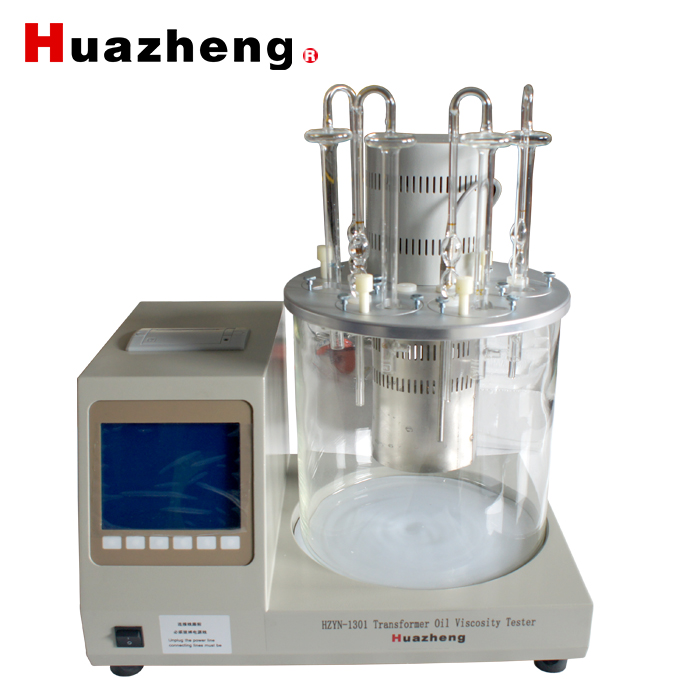
The kinematic viscometer is an instrument developed and produced according to the national standard GB/T265-88. Kinematic viscosity for liquid petroleum products. Large-screen LCD display, Chinese data display, man-machine dialogue management interface preset temperature, experiment learning time and other parameters, menu prompts input, more beautiful design, stable, safe and reliable system.
During the exercise, the viscometer is preserved:
1. The instrument storage room should be clean, dry, bright and well ventilated, and the room temperature should not change drastically. A suitable temperature is about 10-16°C. In winter, the instrument cannot be stored near the heating management and schools. A fire extinguishing technical equipment should be provided in the interior design, but instead of using some ordinary acid-base fire extinguishers, liquid carbon dioxide and carbon tetrachloride and new safety fire extinguishers should be used. Do not carry out data storage and information system research on items with acid and alkali odors indoors to prevent corrosion of experimental teaching instruments.
2. The instrument is stored in the warehouse, and the kinematic viscometer should take strict moisture-proof measures. The relative humidity control requirements for warehouse management should be below 60%, especially in the rainy season in the south, and some special moisture-proof measures should also be taken. Air conditioning can be used to control humidity and temperature. Generally, calcium chloride can be used to absorb moisture, and lime blocks can also be used to absorb moisture. For ordinary instruments stored in ordinary rooms, one or two bags of "moisture-proof" must be stored in the dry matter that must be kept in the instrument box. The main economic components of this "moisture-proof agent" are silica gel (sodium silicate) and a small amount of cobalt salt, which are dissolved in water (5% concentration) and sprinkled on the silica gel to heat and dry. Cobalt salts are mainly used as indicators because they are dark blue when dry and pink when wet. After turning red, the silica gel loses its moisture absorption, and must be heated and baked or exposed to sunlight to evaporate the moisture back to purple to dark blue, so that it can continue to be used for learning. Put the silica gel into a small cloth bag (40-80 grams per bag), and put it in the instrument box for use.
3. The instrument should be placed on a wooden cabinet or shelf, not directly on the ground for management. The tripod should be placed horizontally or vertically, and it is not allowed to tilt at will to prevent deformation.
HZYN-1301 Transformer Oil Viscosity Tester

 中文
中文
 English

 +86-312-6775656
 +86 13731210226
 sales03@bdhuazheng.com
