Many people have been using the Karl Fischer moisture analyzer for several years and cannot explain what is happening inside the instrument, only knowing about "injection, waiting for results, and reading". That's no problem, the instrument design is designed to allow people to operate without understanding the principles. But after truly understanding the principle, you will have a clearer understanding of why certain operations cannot be saved, why the electrolyte fails, and under what circumstances the measurement results are unreliable.
Chemical reactions are the core
Karl Fischer reagent is a mixture of iodine, sulfur dioxide, pyridine, and methanol. When the moisture in the sample enters the electrolyte, a two-step quantitative reaction occurs:
Step 1: Water reacts with iodine and sulfur dioxide in the presence of pyridine to produce pyridine hydroiodide and pyridine trioxide; Step 2: Pyridine trioxide reacts with methanol to produce methylpyridine hydrogen sulfate.
The key point is that these two reactions are strictly carried out in proportion, with 1 mole of water consuming 1 mole of iodine. When iodine is consumed, the reaction stops.
How electrolysis produces iodine
The Coulomb method (the method used by HZWS-X2) does not add iodine from the outside, but generates iodine in situ at the anode through electrolysis: 2I ⁻ -2e → I ₂. The generated iodine is immediately consumed by reacting with water, and electrolysis continues as long as there is still water. When the water is depleted, iodine begins to accumulate, and the measuring unit composed of platinum electrodes detects this change to determine the endpoint of electrolysis.
The correspondence between electricity and water quantity
According to Faraday's law, HZWS-X2 adopts the formula W=Q/10.722, where W is the mass of water (in micrograms) and Q is the total electrolytic charge (in millicoulombs). This conversion factor comes from the molar mass ratio of iodine and water, as well as Faraday's constant. It is a rigorous physical and chemical calculation that does not require a standard curve or calibration - this is precisely the advantage of Coulomb's method. As long as the electricity measurement is accurate, the results are reliable.
Why can the accuracy be achieved within ± 2 µ g
HZWS-X2 adopts a switch constant current source electrolytic circuit, and uses two algorithms of blank current compensation and balance point drift compensation for correction, achieving extremely high stability of the measured electrode signal. Within the range of 10-1000 µ g, the accuracy reaches ± 2 µ g; after exceeding 1000 µ g, the accuracy is 0.2%. Resolution of 0.1 µ g is already precise enough for detecting trace amounts of moisture.
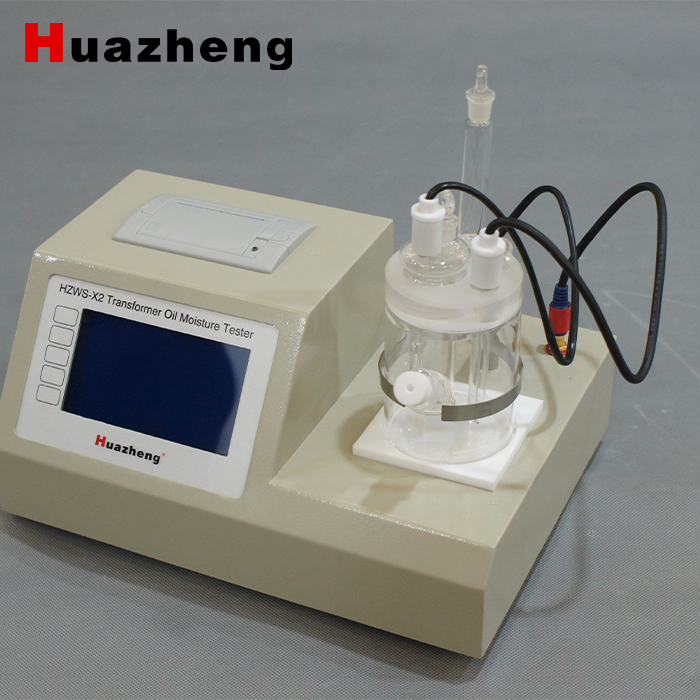
HZWS-X2 Automatic Transformer Oil Moisture Tester

 中文
中文
 English

 +86-312-6775656
 +86 13731210226
 sales03@bdhuazheng.com
